Night Weaning by Age: A Gentle Guide to Reducing Night Feeds
The first two months with my daughter were the hardest of my life.
I was not sleeping. Not in any real way. She fed through the night, and I would lie there in the dark waiting for the next wake-up before the last one had even finished. In the mornings, I would hand her over to my mother-in-law for a few hours just to get some consecutive sleep. I was that tired.
Slowly, after those first couple of months, I started sleeping in bits and pieces. Small windows. Still exhausting, but different. Time passed in that blurry way it does when you are surviving rather than living.
Then, somewhere around six or seven months, I noticed something. She was waking less. Feeding less at night. I remember the confused, slightly panicked feeling — why is she not hungry? Is something wrong? I started watching her more carefully, wondering if I should be doing something differently.
My mother and mother-in-law both said the same thing: ” This is normal. As babies grow, night feeds reduce. It happens gradually. And as solids started coming in, they reminded me that it was actually a good sign — her body was starting to get what it needed from food during the day, so she needed less milk at night.
I got lucky. My daughter did a lot of this naturally.
But I know that is not everyone’s experience. Some babies hold onto night feeds for much longer, and the exhaustion that comes with that is real. This guide walks you through night weaning by age — whether you are wondering if your baby is ready, trying to reduce feeds gently, or just trying to understand what is normal and what is not.
What Is Night Weaning?
Night weaning simply means your baby gradually needs fewer feeds during the night.
It also doesn’t automatically mean your baby will suddenly sleep through the night. Those are two different things. It means your baby gradually needs less milk at night as they grow, develop, and get more of their nutrition from daytime feeds and, eventually, solid foods.
Some babies do this almost entirely on their own, as mine did. Others need a little gentle guidance from you. Both are completely normal.
When Are Night Feeds Actually Needed?
This is important — and honest — to address before anything else.
In the early months, night feeds are not optional. They are essential. Newborns have tiny stomachs and need to feed frequently around the clock, including overnight. Trying to reduce or drop night feeds too early can affect your baby’s weight gain and, for breastfeeding mothers, your milk supply.
The right time to start thinking about night weaning is different for every baby. What matters most is not a specific age but a combination of your baby’s weight, growth, and readiness — which is why your paediatrician or health visitor should always be part of this conversation before you make any deliberate changes.
Night Feeds by Age: What Is Usually Normal
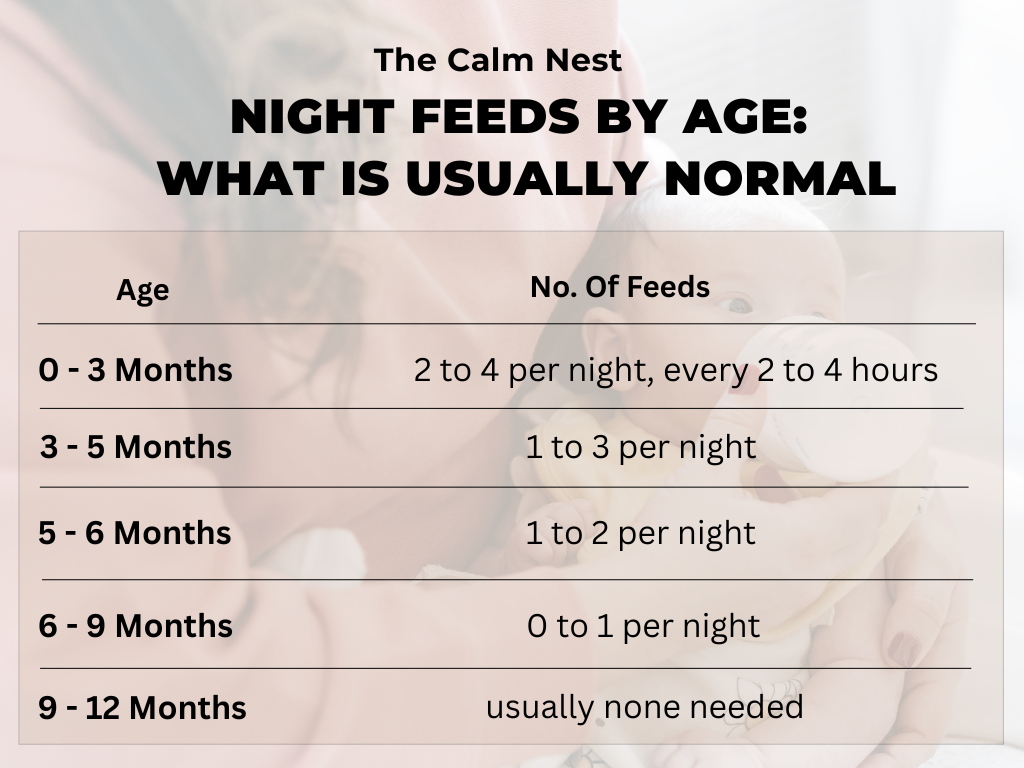
0 to 3 Months
Expected night feeds: 2 to 4 per night, every 2 to 4 hours
This is full night-feeding territory. There is no night weaning at this stage — and there should not be. Your baby’s stomach is too small to go long between feeds, and their nutritional needs are entirely met by milk. Both breastfed and formula-fed babies need regular overnight feeds right through this period.
One thing that does help is keeping night feeds calm and quiet — dim lights, minimal stimulation, no play. This starts teaching your baby the difference between day and night, which matters later.
3 to 5 Months
Expected night feeds: 1 to 3 per night
Some babies start to naturally stretch one longer sleep window in this period — perhaps a four to six-hour stretch between feeds. That is a good sign, and you can follow your baby’s lead.
However, most babies, especially breastfed babies, still need at least one to two overnight feeds in this range. When it comes to dropping night feeds, most experts agree that night weaning is generally not recommended before five to six months, and only when your baby is showing stable weight gain and growing well on their growth curve. Always check with your doctor before deliberately reducing feeds at this age.
5 to 6 Months
Expected night feeds: 1 to 2 per night
Some babies: none
This is when the possibility of night weaning starts to open up for babies who are ready. Many babies around this age can manage a five to six-hour stretch without a feed. Some go longer. As solid foods begin to be introduced around six months, daytime nutrition starts to shift, and the reliance on night milk gradually reduces.
If your baby is showing signs of being less interested in night feeds — shorter feeds, falling back to sleep easily, waking less frequently — these are positive signals that their body is ready to start moving in this direction.
6 to 9 Months
Expected night feeds: 0 to 1 per night
For many babies, the six-to-nine-month window is when night feeds reduce most noticeably. Most babies at this stage who are eating solids and feeding well during the day can manage without any night feeds, though plenty still have one feed in the overnight hours, and that is completely fine too.
This was the stage I noticed the change in my own daughter — less interest, shorter feeds, easier settling. I worried about it at first. I should not have. It was her body doing exactly what it is supposed to do.
9 to 12 Months
Expected night feeds: usually none needed
By nine months, most babies no longer have a nutritional need for overnight feeds, though some will still wake out of habit or comfort. The physical hunger that drives early night feeding has usually shifted to daytime by this stage, especially once solid meals are well established.
If your baby’s pattern doesn’t match these ages exactly, try not to panic. These are general ranges, and it’s completely normal for babies to move through them at their own pace.
Some babies will night wean completely on their own by this point. Others will need gentle help. Both are normal.
Signs Your Baby Might Be Ready to Reduce Night Feeds
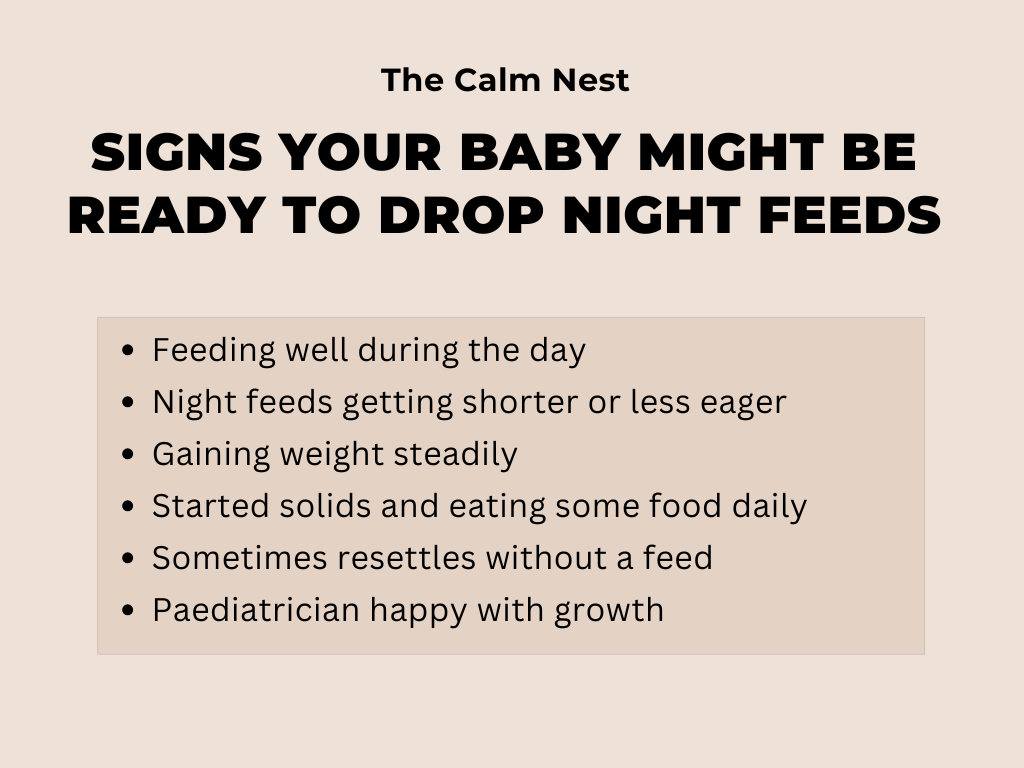
Rather than going purely by age, look for these signs:
- They are feeding well and taking good amounts during the day
- Night feeds are becoming shorter, or they are less eager during them
- They are gaining weight well and growing consistently
- They have started solids and are eating some food each day (usually from around six months)
- They sometimes resettle at night without feeding
- Your paediatrician has confirmed their growth is on track
No single sign tells you everything. I know it’s tempting to look for one clear answer, but readiness is usually a combination of small changes rather than one obvious moment. Looking at the full picture will almost always give you a better answer than focusing on one sign alone.
How to Gently Reduce Night Feeds
If you’re feeling nervous about this part, you’re not alone. Reducing night feeds can feel like a big step, especially if feeding has always been the quickest way to settle your baby. The good news is that it doesn’t have to happen overnight. Small, gradual changes are usually easier for both of you.
If your baby is ready and your doctor is on board, gradual reduction is the approach most families find manageable — and least stressful for both baby and parent.
For breastfed babies — gradual shortening
Reduce the length of each night feed slowly over five to seven nights. If a feed usually lasts ten minutes, try eight minutes, then six, then four, and so on. This gives your baby time to adjust and helps protect your milk supply from dropping too quickly.
For formula-fed babies — gradual volume reduction
If your baby takes more than 60ml per night feed, you can reduce the amount slowly over five to seven nights, by around 20 to 30ml every couple of nights. If your baby takes 60ml or less, you can try stopping that feed and resettling with comfort instead.
Offer more during the day
When night feeds are reduced, increase daytime feeding opportunities to compensate. Your baby should not go hungry — the calories simply shift from night to day.
Use a consistent resettling approach
When you do not feed at a waking, you need to resettle your baby another way. A gentle pat, a quiet voice, or simply your presence can help. It may take a few nights for your baby to accept this — that is expected.
Do not rush
Dropping a feed overnight and immediately seeing your baby sleep through is unusual. Give any change two to three weeks before concluding. Night weaning is a gradual shift, not an overnight fix.
A Note on Natural Night Weaning
Some babies, like my daughter, reduce their own night feeds naturally without any deliberate intervention from you.
If you notice your baby feeding less at night, taking shorter feeds, or waking less frequently — and they are growing well and eating during the day — this is not a problem. It is their body developing exactly as it should.
I remember feeling worried when it happened. I had been so focused on making sure she was getting enough milk that when the night feeds started to drop, my first instinct was that something was wrong. My mother and mother-in-law had to remind me that this was a natural and healthy progression.
If your baby is doing this on their own, you do not need to do anything differently. Just keep feeding well during the day and trust the process.
Common Mistakes to Avoid
Most of us make at least one of these mistakes, usually because we’re exhausted and just trying to get everyone back to sleep. Don’t see this as a checklist of things you’ve done wrong—think of it as a few gentle reminders that can make the process easier.
Rushing it before your baby is ready.
Night weaning before five to six months, or before your baby is gaining weight steadily, can cause real problems. There is no benefit to doing it early. Wait for the readiness signs.
Trying to do it all at once.
Dropping all night feeds in one go is hard on everyone. Gradual reduction over one to two weeks is far gentler and more sustainable.
Confusing habit waking with hunger.
As babies get older, some night wakings are a habit rather than hunger. If your baby wakes, feeds for only a minute or two, and falls straight back to sleep, they may be comfort-feeding rather than hungry. That is useful information as you think about a gentle reduction.
Expecting results on night one.
Any change to feeding patterns takes time for a baby to adjust to. If night one is hard, that does not mean it is not working. Keep going consistently for at least a week before reassessing.
Not increasing daytime feeds.
When night feeds are reduced, daytime feeding needs to carry more of the nutritional load. Do not let the overall amount your baby eats drop — just shift when it happens.
When to Talk to Your Doctor or Health Visitor
Night weaning is not a one-size-fits-all process. Always speak to your paediatrician or health visitor before deliberately reducing night feeds if:
- Your baby is under five to six months old
- Your baby is not gaining weight consistently
- Your baby is unwell or has recently been ill
- You are breastfeeding and worried about milk supply
- Your baby seems genuinely hungry at night despite good daytime feeding
- You have reduced night feeds, and your baby’s weight has dropped, or feeding has changed
Trust your instincts. If something feels off, ask. Early reassurance is always better than weeks of unnecessary worry.
Questions Mums Actually Ask
My baby has started waking more at night after previously sleeping well. Does this mean they need more night feeds again?
Not necessarily. A sudden increase in night waking often has other causes — a developmental leap, teething, illness, or a nap transition. Before reintroducing a night feed, give it a week and consider whether anything else has changed. If your baby is unwell or teething, meet their needs as usual and return to the previous pattern once things have settled.
I am breastfeeding. Will night weaning affect my milk supply?
It can, particularly if done too quickly or too early. Gradual reduction over several nights gives your body time to adjust. Increasing daytime feeds helps compensate. If you are worried about supply, speak to a lactation consultant — they can give guidance specific to your situation.
My baby seems hungry at night even though they eat well during the day. Should I keep feeding?
Yes. If your baby is genuinely hungry, feed them. Night weaning should follow your baby’s readiness, not a fixed date. If daytime feeding seems adequate and night feeds are still long and eager, your baby may simply not be ready yet. That is completely fine.
How do I know if my baby is waking from a habit or hunger?
If your baby wakes, feeds for a very short time, and falls straight back to sleep easily, it may be more of a habit than hunger. If they feed eagerly for a substantial amount of time, they are likely still hungry. There is no perfect way to tell — but watching the pattern over a few nights usually gives you a clearer picture.
You Will Know When the Time Is Right
Night weaning is one of those things that looks very clear-cut from the outside and much messier when you are inside it.
Some babies make it easy on you by doing most of it themselves. Some need time and gentle help. Some are simply not ready until later — and that is fine too.
What I know now, looking back, is that my instinct to worry when my daughter started feeding less at night was completely unnecessary. Her body was doing exactly what it should. And the fact that I had people around me — my mother and mother-in-law — who had been through it before, made all the difference.
If you do not have that kind of support around you, I hope this guide is the next best thing.
Be patient with the process. Be patient with your baby. And on the hard nights, try to be just as patient with yourself.
Keep Reading
Save this guide for when night feeds start to shift — the change often comes earlier or later than you expect.
These guides work well alongside this one:
→ Baby Bedtime Routine Guide — a consistent wind-down routine makes night weaning easier when the time comes
→ Baby Wake Windows by Age — Understanding wake windows can make settling and overnight sleep feel easier for many babies.
→ How Many Naps Does a Baby Need by Age — daytime sleep and night feeding are more connected than most people realise
Sources
NHS — Helping Your Baby to Sleep | Raising Children Network — Night Weaning and Phasing Out Night Feeds | Raising Children Network — Baby Sleep Patterns 2–12 Months | American Academy of Paediatrics — HealthyChildren.org | Pediatrix — When to Wean Baby from Nighttime Feeds | Huckleberry