How Many Naps Does a Baby Need by Age? 0–12 Month Guide
Honestly, I spent months feeling like I was doing naps completely wrong.
My daughter has always been a light sleeper. Active, alert, and not easy to settle. During her first year, she would sleep for twenty minutes — thirty if I was lucky — then wake up wide-eyed and ready to go. The part that got me most was that I had to stay beside her the whole time. The moment I moved, she was awake. So I would sit there, not daring to breathe too loudly, wondering if this was normal or if I was somehow getting it wrong.
Some days, it felt like naps were taking over everything.
One of the questions I searched constantly as a new mum was how many naps does a baby need by age, because nap schedules seem to change so quickly during the first year.
I kept thinking, is she napping too much? Too little? Should I be following a schedule? Should I just watch her cues?
Nobody really explained that simply knowing how many naps are normal for your baby’s age can take away so much of the guessing.
If you are in the middle of it right now, this guide is for you. Simple numbers, clear explanations, and nothing that will make you feel more overwhelmed than you already are.
Why Nap Numbers Actually Matter
Naps are not optional extras — they are a core part of how babies grow, learn, and process the world around them — too few naps, and overtiredness spills into the night. Too many naps, or naps too late in the day, can sometimes make bedtime harder.
The right number is not about hitting a figure perfectly. It is about knowing the range that works for most babies at each stage, so you have something useful to start from.
How Many Naps Does a Baby Need by Age: 0 to 12 Months
Important note before reading: these are guidelines, not rules.
These ranges are for general guidance only. If your baby was born premature, has feeding concerns, medical needs, or you are worried about their sleep or development, speak with your doctor or health visitor.
Every baby is different. Use this as your starting point and adjust based on what you actually see in front of you.
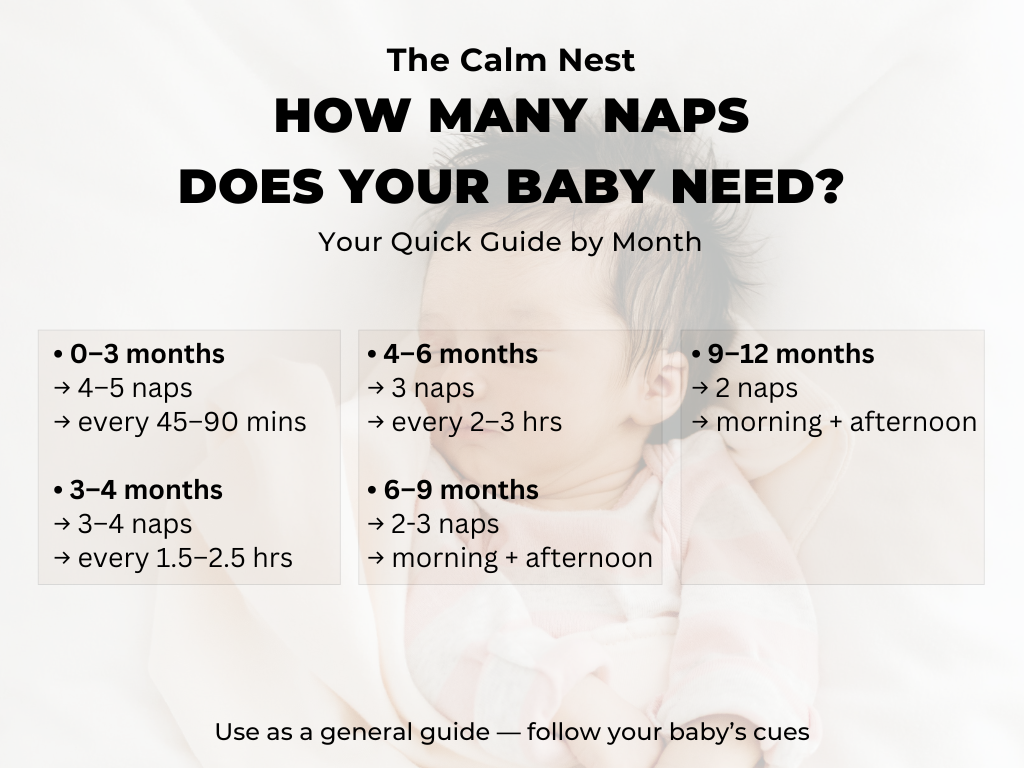
Newborn — 0 to 3 months
Naps: 4 to 5 per day
Total daytime sleep: around 4 to 5 hours
Nap length: 20 minutes to 2 hours — unpredictable
There is no schedule at this stage, and there should not be. Newborns sleep when they need to, wake to feed, and sleep again. Their wake windows are so short — sometimes just 30 to 45 minutes — that naps happen almost continuously through the day. Do not try to organise this into a set routine yet. Respond to your baby’s cues and let them lead.
3 to 4 months
Naps: 3 to 4 per day
Total daytime sleep: around 3 to 4 hours
Nap length: 30 to 90 minutes
A loose shape is starting to form. You may notice your baby becoming more alert between feeds and showing clearer tired signs. This is also when the 4-month sleep regression arrives for many families — naps become shorter and nights more disrupted. It feels like going backwards. It is actually your baby’s sleep maturing, which is a completely normal developmental shift.
4 to 6 months
Naps: 3 per day
Total daytime sleep: around 3 to 4 hours
Nap length: 45 minutes to 2 hours
A gentle rhythm is starting to settle. Most babies this age have a morning nap, a midday nap, and a shorter late-afternoon nap. The goal is not to force specific times but to watch wake windows — usually 1.5 to 2.5 hours at this age — and begin the wind-down before overtiredness sets in.
6 to 9 months
Naps: 2 to 3 per day
Total daytime sleep: around 2.5 to 3.5 hours
Nap length: 1 to 1.5 hours each
Many babies begin moving towards two naps during this period. The third late-afternoon nap is usually the first to go — you will notice it either does not happen or starts pushing bedtime later than you want. That is your signal that two naps are becoming more appropriate.
9 to 12 months
Naps: 2 per day
Total daytime sleep: around 2 to 3 hours
Nap length: 1 to 1.5 hours each
Two naps tend to work well through this period. One thing worth knowing here: many babies show signs of wanting to drop to one nap around 10 to 12 months, but most are not truly ready for that transition until 15 to 18 months. Dropping to one nap too early often creates more problems — overtiredness, frequent night waking, and very early morning starts. If your baby is resisting one nap but clearly still tired, it is usually worth holding the two-nap schedule a little longer.
Signs Your Baby Is Ready to Drop a Nap
Nap transitions happen gradually and can feel messy for a few weeks. Here is what to look for — rather than going purely by age.
Signs it may be time to drop a nap:
- Consistently refusing one nap, even when tired cues are there
- Taking a very long time to fall asleep for naps that used to be straightforward
- Bedtime is becoming significantly later because of a late afternoon nap
- Night sleep is getting shorter with no other obvious cause
- One nap naturally stretches longer to make up for the dropped one
What not to do:
Do not drop a nap after one or two bad days. Teething, illness, developmental leaps, and changes in routine all disrupt nap patterns temporarily. Look for a consistent pattern over one to two weeks before making any permanent change.
How to Handle Nap Transitions Without Losing Your Mind
Most transitions go through a messy in-between phase where some days your baby needs the extra nap and some days they do not. This is normal, and it does pass.
Be flexible for a few weeks
On days your baby seems tired earlier, offer the extra nap. On days they seem fine without it, let it go. This in-between period usually settles within two to four weeks.
Move bedtime earlier on dropped-nap days
When a nap disappears, the gap before bed gets longer, and overtiredness builds fast. An earlier bedtime — even 30 to 45 minutes — prevents it from affecting the whole night.
Follow cues more than the clock during transitions
Your baby’s behaviour is a more reliable guide than a fixed time during any transition period. Stay flexible and adjust as you go rather than rigidly following the old schedule.
Common Mistakes to Avoid
Dropping off a nap after one bad day
One nap refusal is not a transition. A repeated pattern over several days or weeks tells you more than one difficult nap.
Holding on to a nap that the baby has clearly outgrown
If bedtime has become a consistent battle and the afternoon nap feels like the cause, it may be time to let it go, regardless of what the age chart says.
Expecting every nap to be the same length
They will not be. Growth spurts, teething, illness, and new developmental skills all affect nap length day to day. One short nap is not a pattern.
Comparing your baby’s naps to someone else’s
Some babies sleep more during the day. Some sleep less. My daughter has always been on the shorter end, and she is perfectly healthy. Total sleep across the full day matters more than how long any single nap runs.
When to Talk to Your Doctor or Health Visitor
Most nap struggles sort themselves out with time and small adjustments.
It is worth speaking to a professional if:
- Your baby seems consistently exhausted despite what appears to be adequate sleep
- Nap resistance is accompanied by signs of discomfort, pain, or illness
- Your baby is sleeping significantly below the lower end of the recommended range for their age over a sustained period
- You have adjusted the schedule repeatedly, and nothing is improving after several weeks
Trust yourself here. If something feels genuinely wrong beyond normal nap frustration, there is never any harm in asking.
Questions Mums Actually Ask
My baby only naps for 20 minutes. Is something wrong?
Short naps are very common between 3 and 6 months — babies are still learning to connect sleep cycles, and waking after 20 to 30 minutes is developmentally normal. Check the wake window before the nap first, and remember that some babies are simply natural short nappers.
My baby fights every nap, no matter what I do.
Check the wake window — both overtiredness and undertiredness cause nap refusal — and look at your wind-down routine. If your baby has been resisting the same nap consistently for two weeks, it may simply be time to drop it.
We had a great nap routine, and now suddenly everything has fallen apart.
This happens to almost every family and is almost always temporary. The usual causes are teething, illness, a developmental leap, or an approaching nap transition — give it one to two weeks before changing anything.
Should I wake my baby from a long nap?
If a late afternoon nap is running long and affecting bedtime, gently waking after 30 to 45 minutes can protect the night. For all other naps, letting your baby wake naturally is usually the right call.
You Will Figure This Out
Nap schedules feel impossibly complicated when you are inside them and completely obvious in hindsight.
I genuinely wish I had known earlier that my daughter’s short naps were not a failure on my part. Some babies sleep less during the day. That needing to stay beside her was not doing her a disservice — it was what she needed at that stage.
She is 15 months now, and her naps are longer and calmer. We got there slowly, with a lot of adjusting and a lot of patience.
You will get there too. And knowing these numbers — even roughly — means you are already better equipped than I was.
Keep Reading
Save this guide for when nap schedules shift — and they will, several times before the end of the first year.
If you have not already, the guide on baby wake windows by age works alongside nap numbers to help you understand exactly when your baby is ready for sleep at every age.
Sources
Want Simple Baby Sleep Help?
Join The Calm Nest for gentle routines, realistic sleep tips, and simple guidance for real parents.
No pressure. Just support.