Baby Bedtime Routine: A Step-by-Step Guide for 0–12 Months
For a long time, I thought that if my daughter was tired enough, she would just sleep.
She was active all day, barely napped, and by evening, she was clearly exhausted. I remember thinking — surely this means tonight will be easy. She has to sleep now.
It never worked that way.
She would fight bedtime for what felt like hours. Some evenings, I would finally get her asleep, tiptoe out of the room, and she would wake again before I had even sat down. She would finally go down late — sometimes really late — and I would be sitting there wondering what I was doing wrong. I tried to do a bedtime routine. I really did. But without understanding why it worked or how to time it, it felt like I was going through motions that led nowhere.
What I know now — and wish I had understood then — is that tiredness alone does not make babies sleep well. An overtired baby is actually harder to settle, not easier. And a bedtime routine only starts working when the rest of the day’s sleep is roughly in place too. The moment my daughter’s naps settled, her evenings changed. Even now, if one nap goes wrong, I can feel it at bedtime. Everything is connected.
If your evenings feel like a battle right now, you are not doing it wrong. You are probably just missing a few pieces. This guide will help you put them together.
When Should You Start a Bedtime Routine?
Earlier than most people think.
You can introduce a gentle, loose routine as early as six to eight weeks. It does not need to be formal or strict at that stage — even two or three calming steps done in the same order each night start building an association between those steps and sleep.
The clearest results tend to come from around three months, when your baby begins to develop a sense of day and night, and their body clock starts to mature. This is the stage at which most families find that a consistent routine begins to make a noticeable difference.
If your baby is older and you are only starting now, that is completely fine. It is never too late to introduce a routine. Give it two to three weeks of consistency before judging whether it is working — results rarely happen overnight.
What Actually Makes a Bedtime Routine Work?
Not the bath. Not the specific song. Not the exact time.
What makes a bedtime routine work is not the specific steps. It is the repetition. When the same things happen in the same order every night, your baby starts to understand what is coming next. Over time, bedtime stops feeling like a surprise and starts feeling familiar. Babies cannot tell the time. But they are very good at reading sequences. When the same steps happen in the same order each night, babies begin to connect those steps with sleep. After a while, you can almost see them starting to settle before they even get to bed.
A good routine does not need to be long or complicated. Most families use somewhere between 20 and 45 minutes. What matters more than length is consistency — the same steps, the same order, every night, even when it feels like it is not working yet.
Baby Bedtime Routine by Age: 0 to 12 Months
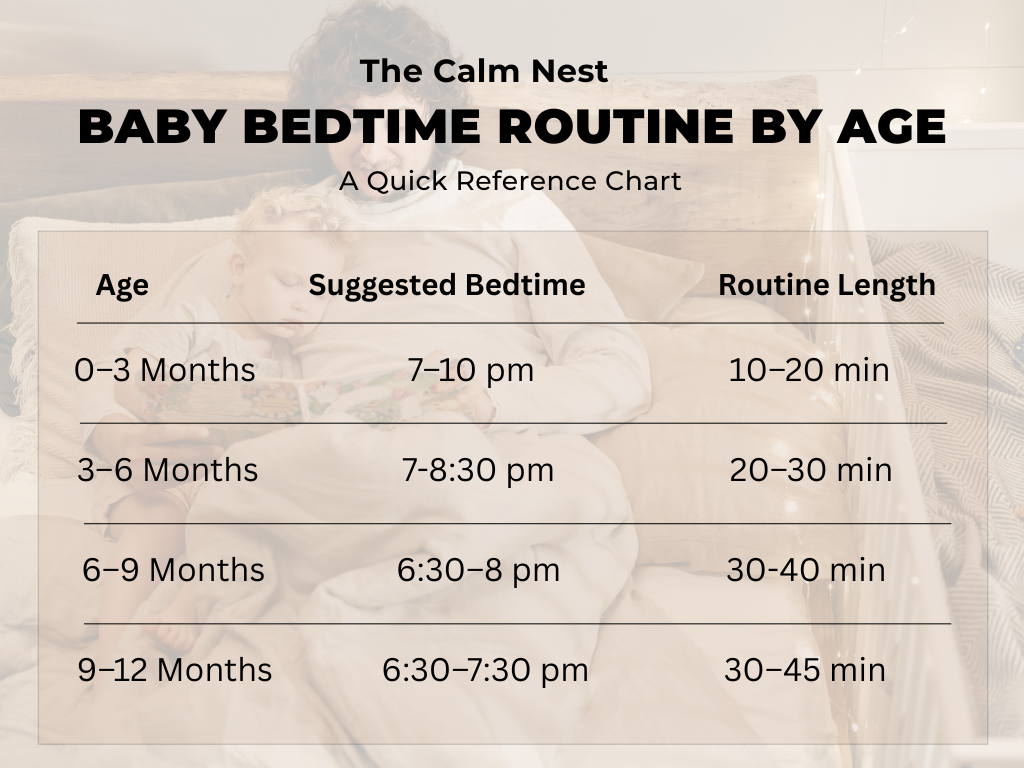
Newborn — 0 to 3 months
Suggested bedtime: flexible, usually 7 pm to 10 pm
Routine length: 10 to 20 minutes
There is no formal schedule at this stage, and there should not be. Newborns do not yet have a developed body clock, and their sleep is driven entirely by hunger and tiredness rather than time of day. A gentle, loose sequence is enough — a feed, a nappy change, a dim room, a quiet cuddle, and sleep. The goal is simply familiarity, not structure.
3 to 6 months
Suggested bedtime: 7 pm to 8:30 pm
Routine length: 20 to 30 minutes
This is a good time to start a more intentional routine. Your baby is beginning to understand the difference between day and night, and a consistent sequence of calming steps starts to genuinely signal that sleep is coming. A simple routine might include a bath or warm wipe-down, a feed, dimming the lights, and a short song or gentle rocking before going down.
This is also the stage where many parents start expecting bedtime to become easier. Sometimes it does. Sometimes it feels harder before it gets better. That does not mean the routine is not working.
6 to 9 months
Suggested bedtime: 6:30 pm to 8 pm
Routine length: 30 to 40 minutes
One important change at this stage — move the feed to the beginning of the routine rather than the end. If your baby consistently falls asleep during the feed, they start to rely on feeding as the thing that puts them to sleep, which makes settling harder later. Feed first, then the rest of the routine, then into the cot. If your baby has always been fed to sleep, do not worry if this change takes time. Most babies need a little practice before a new routine feels normal. At this age, you can also add a short board book, which begins to build a reading habit your baby will love as they grow.
9 to 12 months
Suggested bedtime: 6:30 pm to 7:30 pm
Routine length: 30 to 45 minutes
Your baby is more alert and active now, which means the wind-down needs to do more work. Start reducing stimulation earlier in the evening — lower the lights, quieten the environment, step away from active play. The routine itself can include feed, a short book, pyjamas, a song or cuddle, and sleep. If any teeth have appeared, a gentle toothbrush fits naturally into this stage, too.
A Simple 5-Step Bedtime Routine
This works across most ages and can be adjusted as your baby grows.
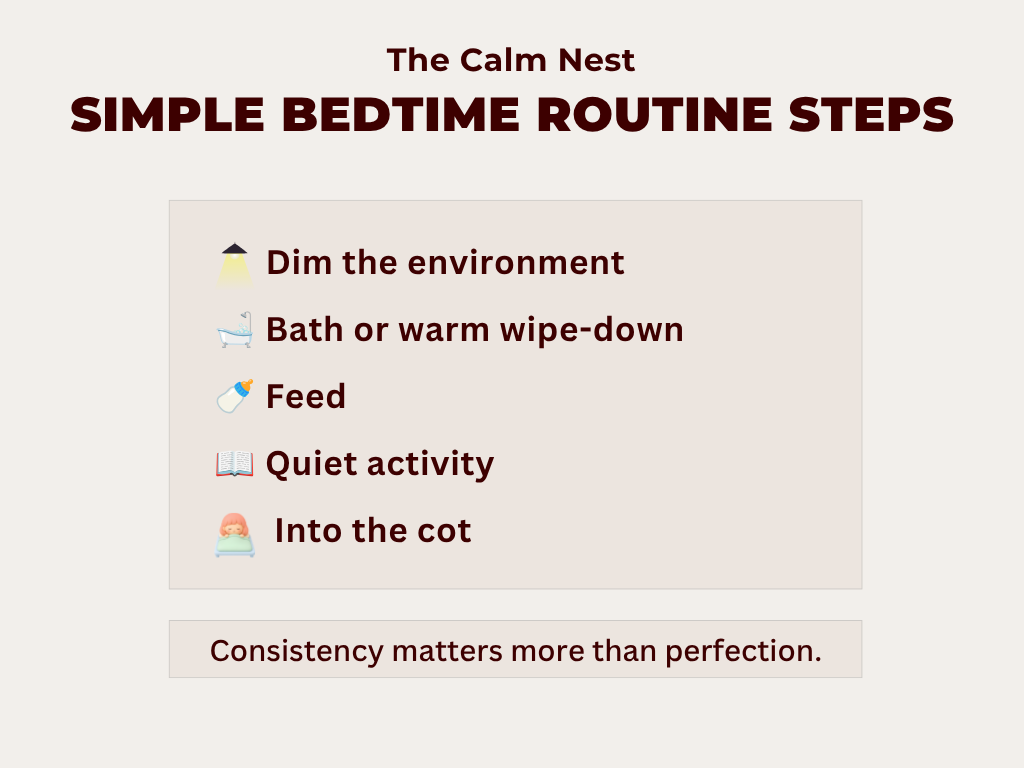
Step 1 — Dim the environment
Lights lower, screens off, noise reduced. This signals the shift from day to night before the routine even properly starts.
Step 2 — Bath or warm wipe-down
A bath is lovely, but not essential every night. A warm wipe of the face and hands works just as well on non-bath nights and still signals calm.
Step 3 — Feed
For younger babies, this comes towards the end. From around six months, move it earlier in the routine to reduce the feed-to-sleep association.
Step 4 — Quiet activity
A short book, a gentle song, a cuddle in a dim room. Keep it calm and keep it consistent.
Step 5 — Into the cot
From around four months onwards, aim to put your baby down drowsy but still awake when you can. This gives them the chance to practise settling, which pays off over time.
Common Bedtime Struggles and What Helps
Baby is wide awake at bedtime and shows no signs of tiredness.
Check the wake windows for your baby’s age. If the last nap of the day ended too close to bedtime, there may not be enough sleep pressure built up yet. Try pushing bedtime slightly later, or capping the last nap earlier in the day.
Baby falls asleep during the feed every night.
Very common in younger babies and not something to stress about early on. From around six months, try moving the feed to the start of the routine and keeping baby gently stimulated — a nappy change, getting dressed for bed — to help them stay awake through to the cot.
Baby cries when put down.
This is one of the most common bedtime struggles, and it is rarely about the routine itself. More often, it is overtiredness, an undertired baby, or simply that they have not yet learned to settle without help. Stay consistent with the routine — the predictability itself is part of what eventually helps.
The routine is taking over an hour every night.
A long bedtime usually means something earlier in the day needs adjusting — either the last wake window is too short, the final nap ran too late, or bedtime itself is too early. Check the nap schedule for your baby’s age and see if anything needs shifting.
Common Mistakes to Avoid
Believing a tired baby will automatically sleep well.
This is one of the most common myths in baby sleep, and I believed it completely. Overtiredness actually makes settling harder, not easier. The goal is to catch your baby at the right level of tiredness — not past it.
Starting the wind-down too late.
If you begin the routine when your baby is already overtired, you are already behind. Start before the peak tired signs appear — use your wake windows as a guide.
Changing the routine when it does not seem to be working.
This is when consistency matters most. Most routines feel a little pointless at first. Then one day you realise your baby already knows what comes next. That usually takes a couple of weeks, not a couple of nights. Changing things after a few bad nights resets the clock.
Too much stimulation close to bedtime.
Bright lights, active play, screens, and loud toys all signal wakefulness to a baby’s nervous system. Start lowering the energy of the evening well before the formal routine begins — ideally 30 to 45 minutes before.
When to Talk to Your Doctor or Health Visitor
Most bedtime struggles improve with time, consistency, and small adjustments.
It is worth speaking to a professional if:
- Your baby seems consistently impossible to settle, despite a calm, consistent routine over several weeks
- Bedtime is accompanied by signs of pain, discomfort, or unusual distress
- Your baby is regularly sleeping significantly less than the recommended range for their age
- Sleep difficulties are noticeably affecting your baby’s mood, feeding, or development
- The situation is seriously affecting your own well-being over a sustained period
Trust your instincts. If something feels like more than a routine sleep challenge, there is never any harm in asking.
Questions Mums Actually Ask
My baby has a routine, but it still takes ages to settle. Why?
A routine creates the conditions for sleep — it does not guarantee instant sleep. If settling is taking a long time, check the timing. Starting the routine too early or too late both make settling harder. Adjust by 15 minutes earlier and give it a few nights.
Do I have to do a bath every single night?
No. A bath is one option for signalling wind-down, not a requirement. A warm wipe-down, a change into pyjamas, and lowered lights do the same job. What matters is the sequence, not the specific steps.
We had a good routine, and now it has stopped working.
This happens, and it is almost always temporary. Growth spurts, teething, developmental leaps, and nap transitions all disrupt bedtime temporarily. Keep the routine consistent and give it a week or two before making changes.
What if my baby falls asleep before the routine is finished?
It happens. Do not wake them to finish the steps. Over time, as the routine becomes familiar, your baby will stay awake through it more reliably. For now, let them sleep.
One Step at a Time
A bedtime routine does not need to be perfect to work. It just needs to be calm, consistent, and repeated.
Some nights will be harder than others. Some weeks will feel like you have gone backwards completely. That is not failure — that is just the reality of the first year, and almost every parent goes through it.
What helped me most was accepting that the routine was something I was building over weeks, not fixing in a night. Once I stopped expecting immediate results and just kept going, things gradually shifted.
Keep the steps simple. Keep the order the same. Be patient with yourself and with your baby.
One day, it will feel less like a battle and more like something your baby understands.
Keep Reading
Save this guide for the evenings when bedtime feels hard — which means you will probably want it again soon.
If bedtime still feels hard, these two guides will help you understand the timing behind it.
→ Baby Wake Windows by Age — timing your routine around wake windows makes everything work better
→ How Many Naps Does a Baby Need by Age — your baby’s daytime sleep directly affects how bedtime goes
Sources
American Academy of Paediatrics — HealthyChildren.org: Getting Your Baby to Sleep | AAP: Brush, Book, Bed | NHS: Helping Your Baby to Sleep | Sleep Foundation | Nemours KidsHealth
Want Simple Baby Sleep Help?
Join The Calm Nest for gentle routines, realistic sleep tips, and simple guidance for real parents.
No pressure. Just support.