Baby Daily Routine by Age: A Simple Guide for 0 to 18 Months
Ayra is 21 months old now, and we finally have a daily routine that works for us.
But it took a long time to get here.
After her first few months, sleep became really difficult. She was a light sleeper, and some of her naps lasted only 15 or 20 minutes. Getting her to sleep at night took effort too. I remember how difficult it was to plan anything when I never knew how long she would stay asleep.
These days are very different.
She wakes up around the same time each morning. After breakfast, we usually spend some time together practising words she knows or trying something new. Then she has snack time, some playtime, lunch, and an afternoon nap that usually lasts around an hour and a half to two hours.
We have a fairly predictable evening routine too, although a trip, illness or even one unusual day can still throw things off.
I wish I had known during those early months that a routine doesn’t have to mean following exact times. And that it can take a while before your baby’s day starts to feel predictable.
In this guide, I want to show you what a daily routine can look like at different ages, from newborn through 18 months.
These are examples to help you plan around your baby, not schedules you have to follow perfectly.
What Does a Baby’s Daily Routine Actually Need?
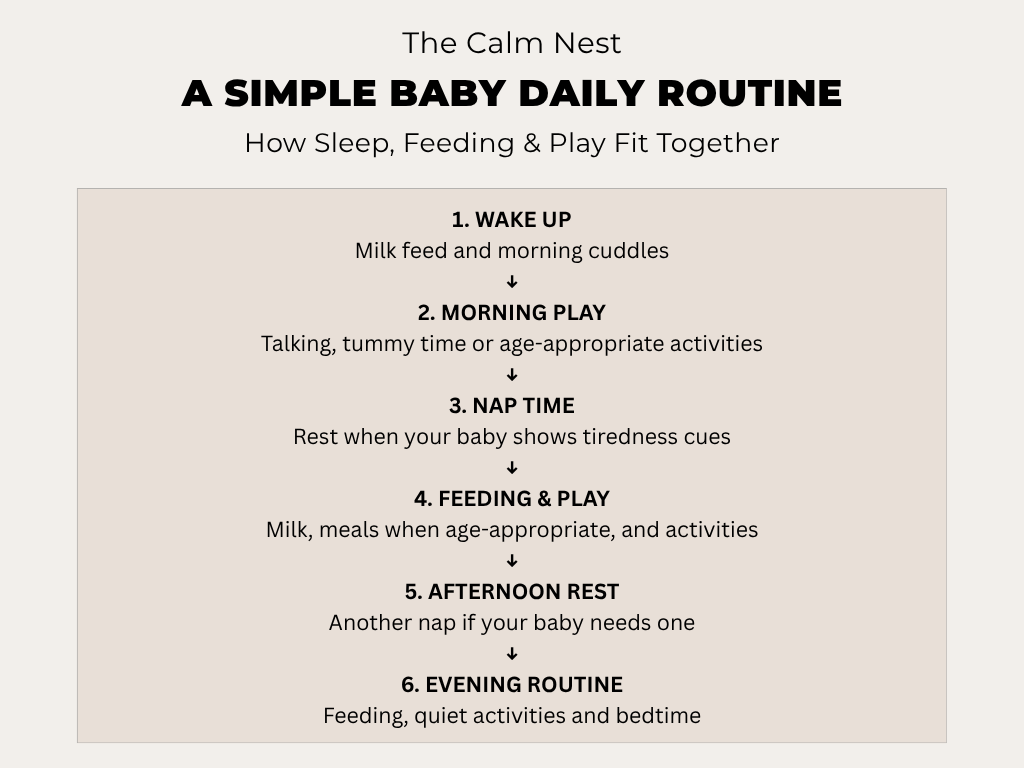
When I think about our routine now, it is really just a familiar order to the day.
Ayra wakes up, we have breakfast, we spend time together, she plays, eats, naps, and eventually we get ready for bed.
We don’t follow every minute on the clock.
Some days lunch is a little later. Sometimes she needs her nap earlier than usual. And sometimes we have plans that change the whole afternoon.
That doesn’t mean we’ve lost our routine.
For younger babies, a routine can be much simpler. It might just mean feeding, a little awake time, and then another sleep.
As your baby grows, you can gradually build meals, playtime and other activities around their natural sleep and feeding patterns.
The aim is to make the day a little more predictable, not to make every day identical.
How Much Sleep Does a Baby Need by Age?
Before looking at sample routines, it helps to understand how sleep needs change during the first 18 months.
| Baby’s age | Sleep across 24 hours | What to expect |
| 0–3 months | Highly variable; newborns often sleep much of the day | Frequent, irregular sleep and waking for feeds |
| 4–6 months | 12–16 hours, including naps | Day and night patterns may become more noticeable |
| 6–9 months | 12–16 hours, including naps | Daytime naps may gradually become more predictable |
| 9–12 months | 12–16 hours, including naps | Many babies have two daytime naps |
| 12–18 months | 11–14 hours, including naps | Some toddlers still take two naps before moving to one |
These are broad sleep recommendations, not targets your baby must reach every single day. Newborn sleep is particularly variable, and babies of the same age may have different patterns.
If you’re unsure how long your baby should stay awake between naps, my Baby Wake Windows by Age guide explains this in more detail.
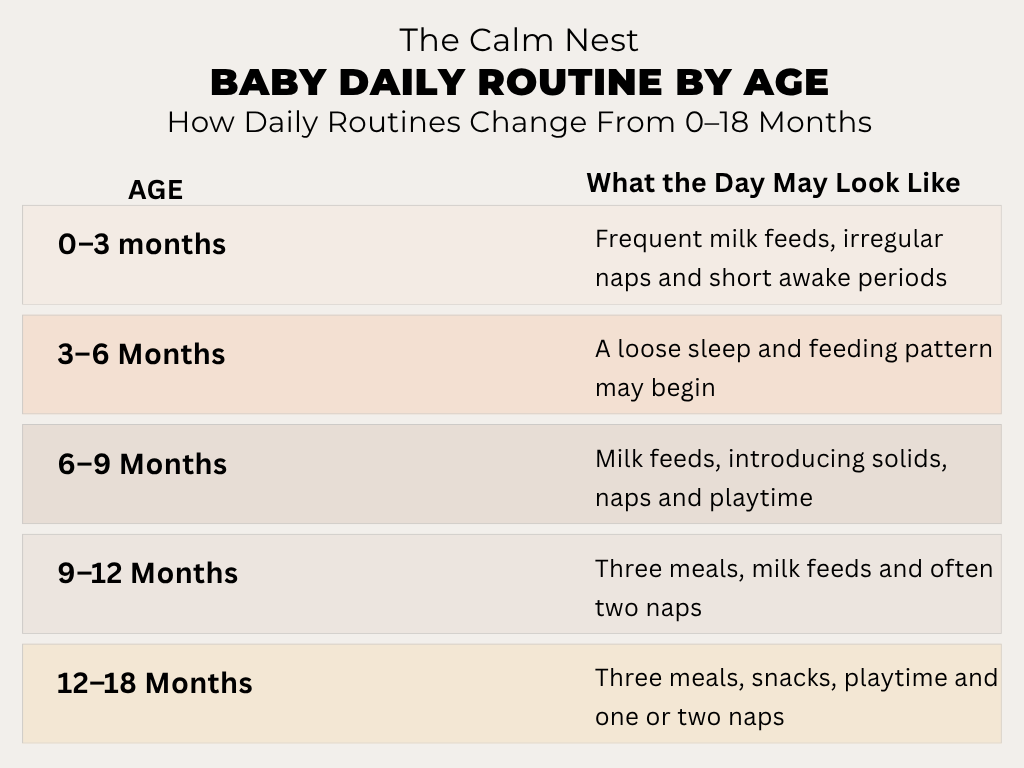
Baby Daily Routine by Age: 0 to 18 Months
0–3 Months: Following Your Baby’s Needs
If you have a newborn, please don’t worry about creating a proper schedule yet.
During these early weeks, feeding and sleeping happen throughout the day and night. Your baby may sleep for a long stretch one day and wake frequently the next.
You might barely finish one feed before it feels like time for another.
And that can make planning anything difficult.
At this age, it’s more useful to follow your baby’s hunger and tiredness cues than to expect meals or naps at particular times.
A simple newborn daily routine
| Part of the day | What it might look like |
| Baby wakes | Milk feed and nappy change as needed |
| After feeding | Cuddles, talking or a little supervised awake time |
| Baby becomes sleepy | Another nap |
| Baby wakes again | Milk feed, comfort and nappy care |
| Throughout the day | Repeat according to baby’s needs |
| Overnight | Keep feeds and changes calm, with low lighting |
This is a repeating pattern, not a timetable. Some newborns will feed or sleep more often than others.
You can begin helping your baby notice the difference between day and night by opening the curtains during the day and keeping nighttime feeds quiet and calm.
You don’t need to keep the house completely silent during daytime naps.
At this stage, what matters most is responding to your baby’s needs, not getting them onto a schedule.
3–6 Months: A Loose Pattern May Begin
Around this stage, you might start noticing certain things happening at similar times.
Maybe your baby tends to wake around the same time in the morning.
Maybe they usually get sleepy after a certain amount of awake time.
Or perhaps one nap is becoming a little more predictable.
Not every baby develops these patterns at the same age, so don’t worry if yours still seems unpredictable.
This is also the age when Ayra’s sleep became more difficult for us. Her short naps made it hard to plan our day because I never knew whether she would sleep for 15 minutes or longer.
If your baby is doing something similar, it doesn’t mean you’re failing to build a routine.
Sample daily routine for 3–6 months
| Part of the day | Activity |
| Morning | Wake, milk feed and nappy change |
| After feeding | Talking, tummy time while awake and supervised, or gentle play |
| When sleepy | Morning nap |
| Late morning | Milk feed, cuddles and play |
| Midday/afternoon | Further naps, feeds and awake time |
| Evening | Quieter activities and a familiar bedtime routine |
| Overnight | Milk feeds and comfort as needed |
At this age, some babies have several daytime naps, while others begin settling into fewer, longer naps.
Rather than trying to match an exact number of naps, notice when your baby starts showing signs of tiredness.
If you want to introduce a bedtime routine, it can be as simple as changing into night clothes, dimming the lights, feeding, and having a cuddle or quiet song.
You don’t need a long list of activities.
6–9 Months: Making Room for Meals and Play
Around six months, another part of the day begins to change: introducing solid foods.
At first, your baby is learning about food rather than eating full meals.
You may begin with a small amount once a day and gradually offer more as your baby becomes comfortable with different tastes and textures.
Breast milk or infant formula remains important throughout the first year.
As your baby gets older, you may find that naps and feeding start falling into a more familiar pattern.
Sample daily routine for 6–9 months
This example shows a baby having two daytime naps. Babies who still need a third nap may have a different afternoon and bedtime.
| Time | Activity |
| 7:00 am | Wake and milk feed |
| 8:00 am | Breakfast or solid-food practice |
| 9:30 am | Morning nap |
| 11:00 am | Wake, milk feed and play |
| 12:00 pm | Lunch, as solids increase |
| 1:30 pm | Afternoon nap |
| 3:00 pm | Wake, milk feed and play |
| 5:00 pm | Evening meal, if established |
| 6:30 pm | Quiet time and bedtime routine |
| 7:00 pm | Bedtime |
Remember: These are illustrative times, not a recommended schedule for every 6–9-month-old.
At the beginning of this age range, your baby may only be having one small solid-food meal. By around 7–9 months, many babies are gradually moving towards three meals alongside their usual milk feeds.
There is no need to rush that change.
Try to offer food when your baby is alert and not already exhausted. A baby who is desperate for a nap may not be interested in sitting down to eat.
And if your baby still takes three naps, that’s fine. You can move meals and playtime around the extra sleep.
9–12 Months: A More Predictable Day
By this age, many babies are taking two naps, one in the morning and another in the afternoon.
Meals may also be easier to plan because your baby is gradually becoming used to breakfast, lunch and dinner.
That doesn’t mean every day will run smoothly.
Some babies still wake several times at night. Others take short naps or suddenly resist a nap they usually take without any trouble.
But you may find that the day has become a little easier to organise.
Sample daily routine for 9–12 months
| Time | Activity |
| 7:00 am | Wake and milk feed |
| 8:00 am | Breakfast |
| 9:30 am | Morning nap |
| 11:00 am | Wake, milk feed and play |
| 12:00 pm | Lunch |
| 2:00 pm | Afternoon nap |
| 3:30 pm | Wake, milk feed and play |
| 5:30 pm | Dinner |
| 6:30 pm | Bedtime wind-down and milk feed as needed |
| 7:00 pm | Bedtime |
The timing of milk feeds can vary depending on whether your baby is breastfed or formula-fed and how much solid food they are eating.
By around 10–12 months, babies are generally having three meals alongside their usual milk feeds.
They don’t need a separate snack schedule before their first birthday. If they’re hungry between meals, you can offer an additional milk feed.
If you’re wondering whether your baby should still be taking two naps, you can also read How Many Naps Does a Baby Need by Age?
12–18 Months: A Toddler Routine Begins
This is the stage when meals, snacks, playtime and naps may start fitting together more comfortably.
Your toddler can take part in more activities, spend longer playing, and begin joining in with everyday family routines.
This is also the period when many toddlers move from two naps to one.
But the change doesn’t happen at the same age for everyone.
Some 12-month-olds still need two naps, while older toddlers may be comfortable with one longer afternoon nap.
So I’ve included both examples.
Sample daily routine for 12–18 months: Two naps
| Time | Activity |
| 7:00 am | Wake and breakfast |
| 9:00 am | Morning play or outdoor time |
| 9:30 am | Morning nap |
| 10:30 am | Wake and snack |
| 12:00 pm | Lunch |
| 1:30 pm | Afternoon nap |
| 3:00 pm | Wake and snack |
| 3:30 pm | Playtime or family activities |
| 5:30 pm | Dinner |
| 6:30 pm | Bedtime routine |
| 7:00 pm | Bedtime |
Sample daily routine for 12–18 months: One nap
| Time | Activity |
| 7:00 am | Wake and breakfast |
| 9:00 am | Playtime, books or outdoor activities |
| 10:30 am | Morning snack |
| 12:00 pm | Lunch |
| 1:00 pm | Afternoon nap |
| 3:00 pm | Wake and snack |
| 3:30 pm | Playtime |
| 5:30 pm | Dinner |
| 6:30 pm | Quiet activities and bedtime routine |
| 7:00 pm | Bedtime |
These examples are starting points. Your toddler may wake later, nap at a different time or need a different bedtime.
Don’t rush the move to one nap just because your toddler has turned one.
If your child is still sleeping well with two naps, you don’t need to remove one simply to match a sample routine.
What our routine looks like now
Ayra is a little older than this age range, but our current routine is closest to the one-nap example.
She usually wakes around the same time, and after breakfast we spend time together practising words, learning something new or simply playing.
Then comes her snack, more playtime, lunch and her afternoon nap.
She usually sleeps for around an hour and a half to two hours before we continue with the rest of our day.
I like having that time together in the morning. It’s become one of my favourite parts of our routine.
We didn’t begin doing all these activities at once. They became part of our day gradually as she grew older and started showing more interest in learning and playing.
And honestly, having a predictable nap time has made it much easier for me to plan the rest of the day too.
How to Build a Daily Routine That Works for Your Baby
If you are starting from scratch, you don’t need to plan every hour.
I would begin with three simple things.
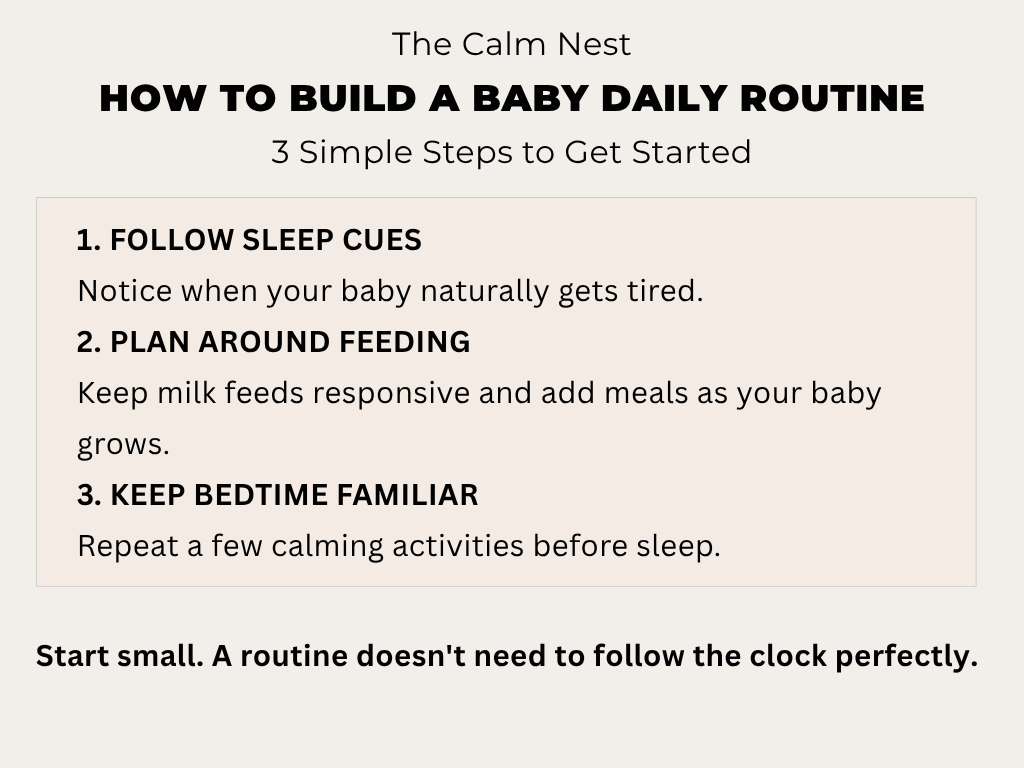
1. Notice when your baby usually sleeps
For a few days, pay attention to when your baby naturally gets tired.
Do they usually need a nap soon after their morning feed?
Are they happier having some playtime before sleeping?
You may begin noticing a loose pattern, especially as your baby gets older.
You can use that pattern as a starting point rather than deciding on a nap time first and trying to make your baby follow it.
2. Fit feeding and meals around their needs
For newborns and younger babies, milk feeds should follow their needs and any feeding advice you’ve been given.
Once solids begin, you can gradually introduce mealtimes without expecting your baby to eat large amounts immediately.
As your baby approaches toddlerhood, meals and snacks may become more predictable.
The important thing is that feeding remains responsive, even when you have a usual routine.
3. Keep bedtime familiar
You don’t need an elaborate bedtime routine.
A few familiar activities in a similar order can be enough.
For example, changing clothes, dimming the lights, having a feed or cuddle, and settling down for sleep.
If bedtime is difficult, my Baby Bedtime Routine Guide explains how to build a simple wind-down without making the evening more complicated.
What If Your Baby’s Routine Suddenly Stops Working?
This is something I think almost every mother deals with at some point.
You finally begin to understand your baby’s day, and then suddenly the naps change, bedtime becomes difficult, or your baby starts waking more often.
It can be frustrating, especially when you’ve spent weeks trying to make things more predictable.
Before changing the whole routine, try to understand what’s different.
Has your baby been unwell?
Are they getting tired earlier than usual?
Have their naps become shorter or longer?
Or has something changed in your usual day?
Sometimes a small adjustment is enough. Other times, you may need to give your baby a little flexibility while things settle.
With Ayra, even now, a trip or illness can affect our routine. We usually return to our familiar meal, play and sleep pattern when things are back to normal.
I don’t try to make up for every missed nap or force the next day to be perfect.
If sleep problems continue, your baby seems unwell, or you’re concerned about feeding, it’s better to ask for professional advice than simply wait for the routine to improve.
Common Baby Routine Mistakes to Avoid
Trying to follow a strict newborn schedule
Newborns need frequent feeds and responsive care.
It’s fine to have a familiar order for simple activities, but avoid delaying feeds or keeping a tired newborn awake just to follow a timetable.
Following someone else’s schedule exactly
A routine you see online might look perfect.
But your baby may wake at a different time, take shorter naps or need feeds at different intervals.
Use sample schedules for ideas, not as rules.
Ignoring tiredness because it isn’t nap time yet
If your baby is clearly sleepy, you don’t need to keep them awake just because the schedule says they should nap later.
A routine should make your day easier, not leave you constantly watching the clock.
Changing everything after one difficult day
One missed nap or difficult bedtime doesn’t automatically mean the routine needs replacing.
Look at what happened and make changes when they’re actually needed.
You can keep the parts that are working instead of starting again every time something goes differently.
A Quick Note About Safe Sleep
Whatever daily routine you follow, safe sleep remains important.
For babies under 12 months, always place them on their back to sleep on a firm, flat, clear sleep surface designed for infants.
Keep pillows, loose blankets, soft toys and other soft items out of their sleep space.
For at least the first six months, your baby should sleep in their own separate sleep space in the same room as you, including for daytime naps.
A predictable routine should never come at the expense of safe sleep.
When to Speak to Your Doctor or Health Visitor
Most babies go through periods when sleep and daily routines are unpredictable.
But it’s worth asking for advice if:
- Your baby regularly seems unusually sleepy or difficult to wake.
- You’re concerned that your baby isn’t feeding enough or gaining weight as expected.
- Your baby seems uncomfortable, unwell or in pain.
- Sleep difficulties are persistent and affecting your baby’s wellbeing.
- You’re struggling to cope with the amount of sleep you’re getting.
You don’t have to wait until things become overwhelming before asking for support.
Questions Parents Often Ask
My baby has no routine at all. Where should I start?
Start small.
If you have a newborn, focus on feeding, sleep and responding to their needs rather than setting fixed times.
For an older baby, notice when they usually wake, feed and nap. You can gradually introduce familiar activities around those patterns.
You don’t need to create an entire schedule in one day.
Should my baby wake up at the same time every morning?
Not necessarily.
As babies grow older, a fairly consistent morning routine may help make the rest of the day more predictable.
But you don’t need to wake a sleeping newborn at a particular time just to establish a routine. Follow any feeding or waking instructions from your baby’s healthcare professional.
How many naps should my baby take?
It depends on their age and individual sleep needs.
Younger babies usually have several naps throughout the day. As they grow, the number gradually reduces.
Many babies move towards two naps during the later part of their first year, and toddlers eventually move to one.
For a closer look, read How Many Naps Does a Baby Need by Age?
What if my baby doesn’t follow the sample schedule?
That’s completely fine.
The sample routines are there to help you see how naps, feeds, meals and play might fit together.
If your baby wakes later or naps at different times, adjust the routine around them.
You don’t need to follow the exact times for the routine to be useful.
My baby’s routine worked before, but now it doesn’t. Should I change it?
Not immediately.
First, consider whether your baby’s sleep needs have changed or whether something temporary is affecting their day.
If the same difficulty continues, you can adjust one part of the routine and see whether it helps.
And if you’re worried about your baby’s sleep, feeding or health, speak to your doctor or health visitor.
How do I keep a routine when we’re travelling?
Try to keep a few familiar parts of the day, even if the times change.
That might mean having meals in a similar order or following the usual bedtime wind-down.
Ayra’s routine can be disrupted when we travel too. Once we’re home, we gradually return to our normal day.
You don’t need to make every day away from home look exactly like a day at home.
It Took Us Time to Find Our Routine
When I think about those months when Ayra barely napped, our days now feel very different.
We have our usual times for meals, play and sleep, and most days I know roughly what to expect.
It doesn’t always go to plan, but it’s much easier than it used to be.
If your baby is still very young and every day looks different, you don’t need to figure everything out right now.
Start with what you notice about your baby. As their sleep and feeding patterns change, you can adjust the day around them.
And if the routine stops working for a while, that doesn’t mean you have to start all over again.
Keep Reading
If you’re trying to make sense of your baby’s sleep, you might also find these guides helpful:
- Baby Wake Windows by Age — understanding how awake time changes as your baby grows.
- How Many Naps Does a Baby Need by Age? — a guide to daytime naps during the first year.
- Baby Bedtime Routine Guide — simple ways to make evenings more predictable.
You can also explore more baby sleep and routine guides here at The Calm Nest.
Sources
NHS – Introducing Solid Foods and Weaning, NHS – Helping Your Baby to Sleep, and American Academy of Sleep Medicine – Recommended Sleep Duration (2016)
This article is for general information and is not a substitute for individual medical advice from your baby’s doctor or health visitor.