Baby Sleep Schedule by Age: The Complete Guide for 0–12 Months
For a long time, I had no idea what my daughter’s day was supposed to look like.
I was not following a schedule. I was not even trying to. I was just responding — to every wake-up, every cry and every nap that lasted ten minutes before she was awake again.
The days blurred together, and I genuinely could not have told you whether what was happening was normal.
I just knew that nothing felt settled, and I was exhausted in a way I had never been before.
Once I started looking for a baby sleep schedule by age, what I really wanted was not a strict timetable. I just wanted to know roughly what a baby’s day could look like as she got older.
That is what this guide is for.
The schedules below are examples, not rules. Your baby’s naps, feeds, wake-up time and bedtime may look completely different. What matters more is understanding the general pattern and adjusting it around the baby in front of you.
Baby Sleep Needs at a Glance
If you are tired and just want the numbers, start here.
| Age | Total sleep in 24 hours |
| 0–3 months | Around 14–17 hours is a useful reference range, although newborn sleep can vary considerably |
| 4–12 months | 12–16 hours, including naps |
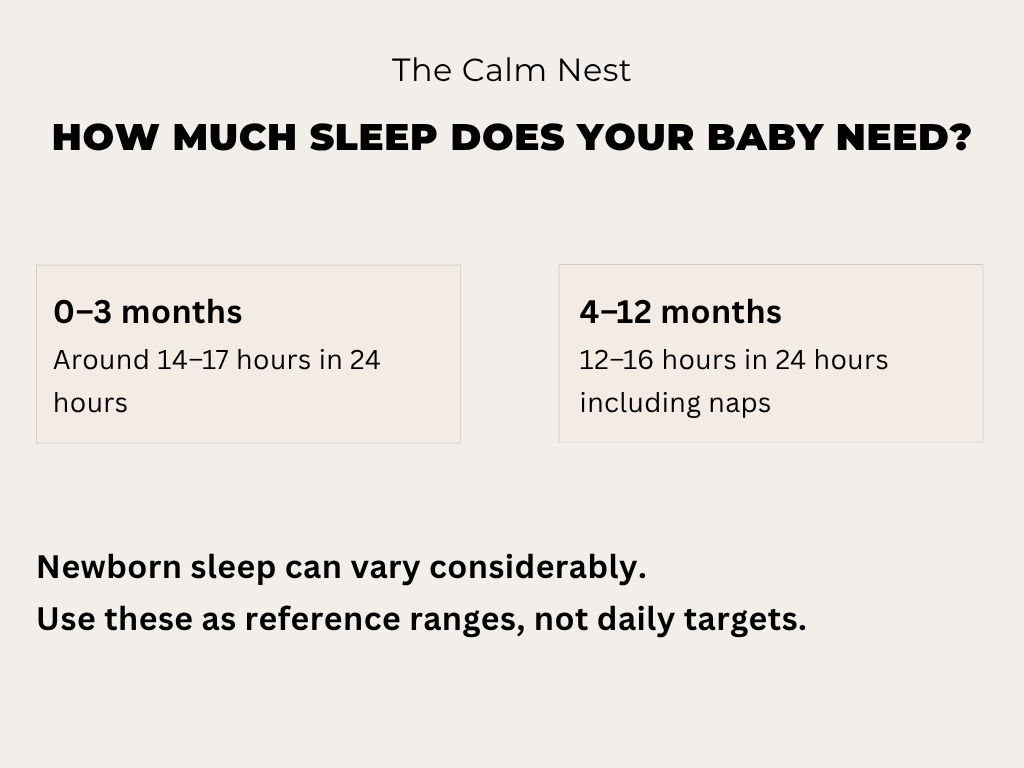
Newborn sleep is especially variable. Some newborns sleep much more than others, and they usually sleep in short stretches during both day and night.
For babies from 4 to 12 months, the recommended 12–16 hours includes both naps and nighttime sleep.
These numbers are guides, not a target you need to make your baby hit every day.
Baby Sleep Schedule by Age: 0–12 Months
Newborn: 0–3 Months
What sleep can look like
The newborn stage is usually the least predictable.
Your baby may sleep in short or longer bursts throughout both day and night and wake frequently to feed. There may not be much difference between daytime and nighttime sleep yet.
A newborn day may simply look like:
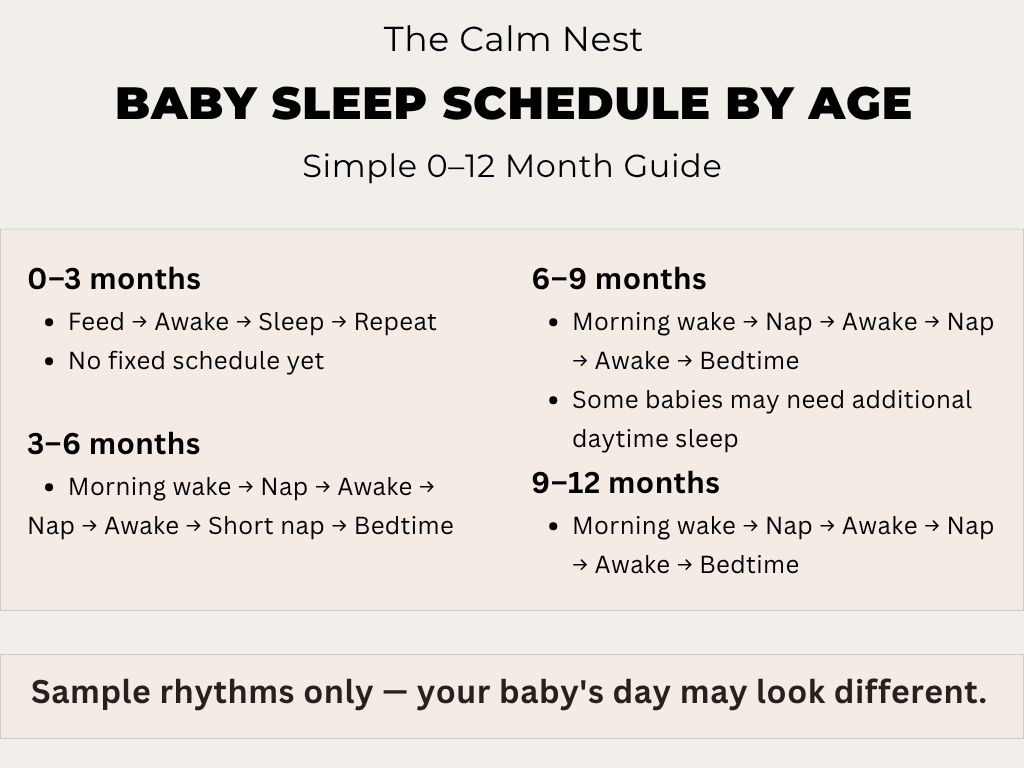
Wake → Feed → Short awake time → Sleep → Repeat
And honestly, knowing that there did not have to be a proper schedule yet would have taken some pressure off me in those early weeks.
One day may look completely different from the next.
What to focus on
Instead of trying to create a clock-based schedule, focus on:
- Feeding your baby as needed
- Responding when they become tired
- Keeping nighttime feeds calm and low-stimulation
- Having normal light, talking and activity during the day
- Following safe-sleep guidance for every nap and nighttime sleep
At this age, you are learning your baby. You do not need to organise every hour.
3–6 Months
This was around the stage when sleep became much harder for us.
Ayra had slept fairly well during her first couple of months, so I was not prepared for the short naps that came later. Some lasted only ten or fifteen minutes. She was also a light sleeper, and there were times when I felt as though I had barely settled her before she was awake again.
I kept wondering what I was doing wrong.
As babies move through these months, their sleep pattern can start becoming more recognisable, but there can still be a lot of variation.
For babies aged 4 months and older, 12–16 hours of total sleep in 24 hours, including naps, is the recommended range.
One example of how the day might flow
This is not a recommended schedule — just an example of how naps could fit around a 7:00 am start.
7:00 am — Wake and feed
8:30 am — Nap
10:00 am — Wake, feed and play
12:00 pm — Nap
1:30 pm — Wake, feed and play
3:30 pm — Short nap
4:15 pm — Wake
6:30 pm — Start bedtime routine
7:00 pm — Bedtime
Your baby’s naps may be much shorter or longer than these. Bedtime may also be earlier or later.
Use the example to understand the shape of the day, not to decide that your baby must sleep at 8:30 am.
Why might sleep suddenly change around 4 months?
You may notice sleep becoming different during these early months.
Naps might shorten. Your baby may wake more often or suddenly become harder to settle.
Infant sleep patterns are still developing during this period, so a change does not automatically mean your previous routine has stopped working.
If it lasts, look at your baby’s overall sleep pattern rather than trying to fix one difficult day.
6–9 Months
By now, you may be able to see more of a pattern in your baby’s day.
Babies aged 4–12 months need 12–16 hours of total sleep in 24 hours, including naps, but how that sleep is divided between daytime and nighttime varies.
One example of how the day might flow
Again, these times are only an illustration.
7:00 am — Wake, feed and play
9:30 am — Nap
11:00 am — Wake
1:30 pm — Nap
3:00 pm — Wake
6:30 pm — Bedtime routine
7:00 pm — Bedtime
Your baby’s day does not need to look exactly like this.
If you are trying to work out how many naps your baby may need at this stage, I would look at that separately rather than trying to squeeze your baby into this example.
→ How Many Naps Does a Baby Need by Age?
That guide goes into nap changes across the first year in more detail.
9–12 Months
By the later part of the first year, you may find that your baby’s days feel more familiar than they did in the newborn months.
The recommended total remains 12–16 hours of sleep in 24 hours, including naps, for babies up to 12 months.
One example of how the day might flow
7:00 am — Wake
9:30 am — Nap
11:00 am — Wake, milk/food and play
2:00 pm — Nap
3:30 pm — Wake
5:30 pm — Dinner and calmer play
6:30 pm — Bedtime routine
7:00 pm — Bedtime
This is one possible day, not a schedule your baby is expected to follow.
If a nap is shorter one day or bedtime shifts, you do not need to rebuild the entire routine.
What About Wake Windows?
Wake windows are simply the periods your baby spends awake between sleeps.
They can be useful as a practical guide, but there is no single official wake-window schedule that every baby needs to follow.
That is why I prefer to use them alongside what the baby is actually doing.
If your baby regularly becomes tired before the suggested wake window ends, you do not need to keep them awake just because a chart says so.
And if they are consistently taking much longer to settle at their usual nap time, their routine may need adjusting.
For age-based examples, you can read:
How to Use a Baby Sleep Schedule Without Watching the Clock All Day
This is the part I wish I had understood earlier.
A schedule can give you a starting point without controlling the entire day.
Start with your baby’s usual morning
If your baby tends to wake at roughly the same time, use that as the beginning of the day.
If they wake much earlier or later one morning, the rest of the day may shift too.
Let naps move when they need to
A short nap may mean the next sleep happens earlier.
A longer nap may move the rest of the day later.
You do not need to keep forcing the original clock times when the day has already changed.
Keep bedtime simple
A calm, familiar bedtime routine can help create a clear end to the day.
It can be very simple: changing into night clothes, dimming the lights, reading, cuddling or singing before bed.
You can find more ideas here:
When the Schedule Suddenly Stops Working
This will probably happen more than once.
You finally think you understand the routine and then naps become difficult, bedtime changes or your baby starts waking more often.
Sometimes the disruption is temporary. Hunger, teething discomfort or illness can all affect sleep.
Other times, the routine that worked a few weeks ago simply no longer fits your baby’s current pattern.
Before changing everything after one bad day, give yourself a little time to see what keeps happening.
If the same problem repeats over several days, then it may be worth adjusting the routine.
A Few Things I Would Not Stress About
Your baby does not follow the sample schedule
They are not supposed to.
The clock times in this guide are examples to help you picture how a day might flow.
One nap suddenly goes wrong
One short nap does not mean the entire routine needs changing.
Look for a pattern over several days.
Your baby’s schedule changes as they grow
A routine that suited your baby a few months ago may not suit them now.
Sleep changes during the first year, so your routine will probably change with it.
Your baby still wakes at night
A daytime routine cannot guarantee uninterrupted nighttime sleep.
Babies can still wake during the night, even when their daytime routine seems to be working well.
A Quick Note About Safe Sleep
The schedule is flexible. Safe sleep is not.
For every sleep:
- Place your baby on their back
- Use a firm, flat, non-inclined sleep surface
- Keep pillows, loose blankets, toys, bumpers and other soft objects out of the sleep space
- Use a sleep space intended for infant sleep, such as an appropriate crib, bassinet or play yard
- Keep your baby’s sleep space in your room, but separate from your bed, for at least the first 6 months
If your baby falls asleep in a car seat, stroller, swing, carrier or sling, move them to an appropriate firm, flat sleep surface on their back as soon as possible.
When to Talk to Your Doctor or Health Visitor
Talk to your baby’s doctor or health visitor if:
- You are worried that your baby regularly sleeps much more or much less than expected
- Sleep difficulties are affecting feeding or growth
- Your baby seems unwell, uncomfortable or in pain
- You have an ongoing concern about your baby’s sleep
- Your own sleep deprivation is becoming difficult to cope with
You do not have to solve every sleep problem by yourself before asking for help.
Questions Mums Actually Ask
Does my baby need exactly the same schedule every day?
No.
A familiar rhythm can be helpful, but naps and bedtime will not always happen at exactly the same time.
Appointments, family visits, short naps, illness and ordinary life can all shift the day.
One different day does not mean you have ruined the routine.
How do I know when the schedule needs changing?
Look for something that keeps happening rather than reacting to one difficult nap.
For example, your baby may repeatedly become tired earlier than usual, take much longer to settle at their normal sleep time, or show a consistent change in their sleep pattern.
Sometimes a small shift is enough.
Is something wrong if my baby still wakes during the night?
Not necessarily.
Night waking can still happen during infancy, even when a baby has a fairly predictable daytime routine.
If the waking is new, very frequent, accompanied by signs of illness or pain, or simply worrying you, talk to your doctor or health visitor.
You Do Not Need a Perfect Baby Sleep Schedule
I wish someone had told me this much earlier.
When you are exhausted, a schedule can look like the answer.
You imagine that if you could just find the right wake-up time, the right nap length and the right bedtime, everything would finally fall into place.
But there will still be short naps.
There will be difficult nights.
There will be days when the whole routine shifts because your baby slept badly the night before.
What helped me most was realising that I did not need to control every sleep. I needed to understand the general pattern and then work from there.
Once I understood what was normal for each stage, those difficult days became a little less frightening.
Keep Reading
If you are trying to make sense of your baby’s sleep, these guides may help:
→ Baby Wake Windows by Age
A practical guide to how awake time changes as babies grow.
→ How Many Naps Does a Baby Need by Age?
A closer look at daytime naps and how they change through the first year.
→ Baby Bedtime Routine Guide
Simple ideas for creating a calmer and more predictable end to the day.
Sources
CDC — About Sleep: Infant Sleep-Duration Guidance | American Academy of Sleep Medicine — Recommended Amount of Sleep for Pediatric Populations: A Consensus Statement | American Academy of Pediatrics — Getting Your Baby to Sleep | American Academy of Pediatrics — How to Keep Your Sleeping Baby Safe: AAP Policy Explained | NHS — Helping Your Baby to Sleep