Baby Milestones Month by Month: Complete First Year Guide
My daughter hit pretty much every milestone right on time. She crawled, although not for very long — she much preferred pulling herself up and walking while holding onto things instead. She babbled exactly when she was supposed to. She clapped early and clearly loved doing it. Once her pincer grip developed, she wanted to feed herself everything, mess and all.
And I still worry constantly.
Her first tooth did not come through until she was thirteen or fourteen months old. I now know that it is within the normal range, but nobody tells you that while you are watching every other baby in your feed posting toothy smiles at six months. I remember checking her gums almost every morning, convinced that today would finally be the day a tiny white tooth appeared. What made it harder was that the teething discomfort actually started around six months, long before any tooth appeared, and it stayed with us for a long time. We are still going through it now, with only four teeth so far.
Her hair grew slowly, too. Barely anything for the first year, and then suddenly, after her first birthday, it started filling in.
Neither of these things turned out to be a real problem. But I want to be honest with you — knowing that did not stop me from worrying at the time.
That is why I wanted to write this guide. I wanted someone to tell me not just what babies usually do each month, but also which things were actually worth worrying about — and which ones really weren’t.
How to Use This Guide
Every milestone listed here is a range, not a deadline. These are based on what most babies can do by certain checkpoint ages — the same checkpoints used at well-baby visits. Most babies will be early with some things and a little later with others. That is completely normal and does not mean anything is wrong.
Think of this as a loose map, not a race.
Baby Milestones Month by Month: 0 to 12 Months
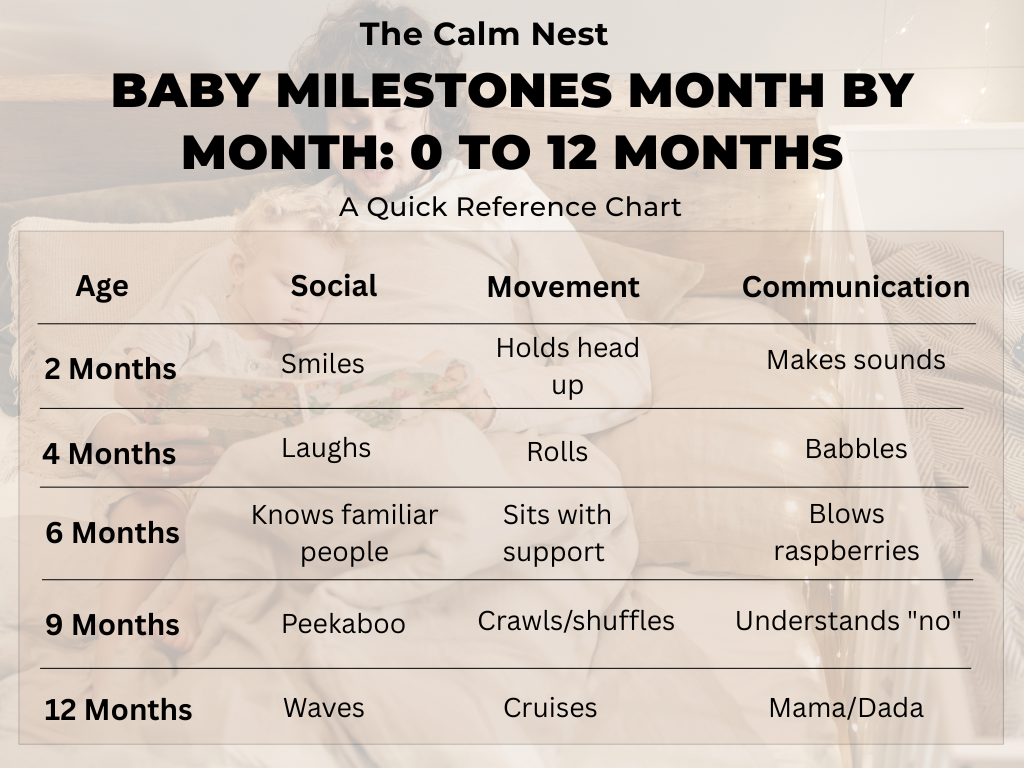
By 2 Months
Social:
Begins to smile at people. Briefly calms when picked up or spoken to.
Movement:
Can hold head up briefly during tummy time. Moves both arms and legs.
Communication:
Makes sounds other than crying. Reacts to loud sounds.
At this stage, your baby is mostly learning that the world is safe and that you respond when they need you. That is the real work happening here, even though it looks like very little is going on.
By 4 Months
Social:
Smiles on their own to get your attention. Begins to copy facial expressions.
Movement:
Holds head steady without support. Pushes up onto elbows during tummy time. May roll from tummy to back.
Communication:
Makes cooing sounds back and forth with you. Begins to babble with different sounds.
This is often when parents start noticing real personality — more eye contact, more reactions, more obvious delight when you talk to them.
By 6 Months
Social:
Knows familiar people. May become shy or wary around strangers.
Movement:
Rolls in both directions. Begins to sit with support, may sit briefly without it. Bears bear weight on their legs when held standing.
Communication:
Takes turns making sounds with you. Blows raspberries. Strings vowel sounds together.
Stranger wariness often starts here, and it can feel sudden — your previously easygoing baby may suddenly cry with people they were fine with before. This is a normal developmental step, not a step backwards.
By 9 Months
Social:
Look for objects you hide. Plays peekaboo. May be clingy with familiar adults.
Movement:
Stands while holding onto something. Sits without support. Moves around — crawling, scooting, or shuffling, in whatever way works for them.
Communication:
Understands “no.” Makes a range of sounds, such as “mamama” and “dadada.” Lifts arms to be picked up.
Not every baby crawls in the traditional sense, and that is completely fine. Some shuffle on their bottoms, some commando-crawl on their bellies, and some skip it almost entirely in favour of pulling up to stand early — as my daughter did.
By 12 Months
Social:
Plays games like peekaboo and pat-a-cake. Waves bye-bye. May show a clear favourite toy or person.
Movement:
Pulls to stand. Walks while holding onto furniture, often called cruising. Some babies take independent steps around this time, though many do not walk fully unassisted until closer to 13 to 15 months.
Communication:
Calls a parent “mama” or “dada” specifically. Understands simple words like “no” or “bye-bye.” Uses a pincer grasp to pick up small items.
By this point, your baby has gone from a newborn who could barely lift their head to a small person actively exploring their world. That is an enormous amount of development packed into twelve months.
Things That Worry Parents But Are Not True Milestones
This is the part I wish someone had told me earlier.
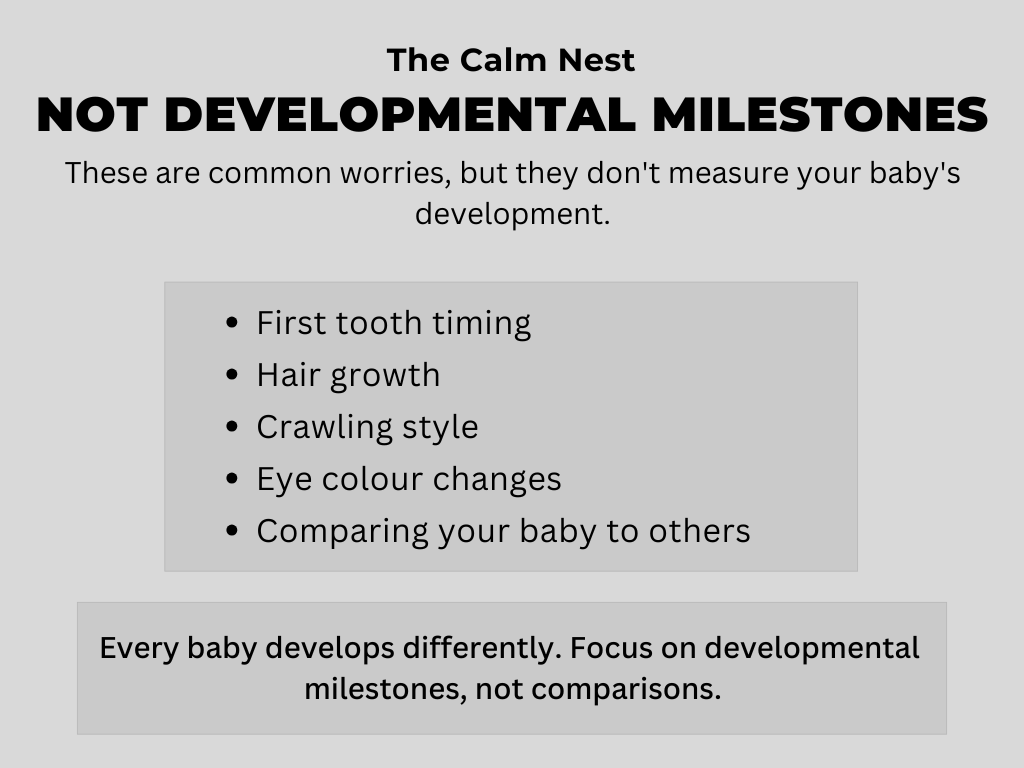
Teething timing is not a developmental milestone.
The first tooth can arrive anywhere from around 4 months to 14 months and still be completely normal. Teething discomfort can also begin months before any tooth is actually visible. A late first tooth says nothing about your baby’s overall development.
Hair growth and thickness vary enormously and mean nothing developmentally.
Some babies are born with a full head of hair that falls out and regrows. Some stay nearly bald for the first year. Hair pattern is genetic and has no connection to anything else about your baby’s growth or progress.
Crawling style and duration are not standardised.
Some babies crawl for months before walking. Some, like my daughter, barely crawl at all and move straight to cruising and walking. Both are within the range of normal development.
If you find yourself comparing your baby’s teeth, hair, or crawling style to another baby’s Instagram photos, please know — none of those things are actually milestones doctors track.
The real milestones are the ones listed above, and even those have wide, normal ranges.
Simple Things You Can Do to Support Development
The good news is that babies don’t need expensive toys or perfectly planned activities. Most development happens through the little things you’re probably already doing every day.
- Talk to your baby constantly, even when it feels one-sided. Narrate what you are doing. This is how language develops.
- Give your baby floor time to move, reach, and explore freely, rather than spending long periods in swings, bouncers, or car seats.
- Read together daily, even briefly. Pointing at pictures and naming things builds language long before your baby can speak.
- Respond when your baby makes sounds at you. This back-and-forth is one of the most powerful things you can do for early communication development.
- Limit screen time for babies under two, where possible. Real interaction supports development far more than screens at this age.
- A predictable bedtime routine and good sleep schedule also genuinely support development — much of what your baby learns during the day gets processed and consolidated during sleep.
When to Talk to Your Paediatrician
Every baby develops at their own pace, and small variations are completely normal. It is worth speaking to your paediatrician or health visitor if:
- Your baby is not meeting several milestones for their age, not just one
- Your baby has lost a skill they previously had
- You notice your baby is not responding to sounds or does not make eye contact
- You have a persistent gut feeling that something is not quite right, even if you cannot explain why
You know your baby best. Acting early on a concern is always the right call — it does not mean something is wrong, it simply means getting clarity sooner rather than later.
Questions Mums Actually Ask
My baby skipped crawling completely. Should I be worried?
Not necessarily. Some babies move straight from sitting to pulling up and walking without a traditional crawling phase. As long as your baby is finding some way to move and explore, this is usually just a different path to the same outcome.
Everyone else’s baby has teeth, and mine does not. Is something wrong?
Almost certainly not. The first tooth can arrive anywhere from 4 to 14 months and still be completely normal. Teething timing has no connection to overall development.
My baby seems behind on one thing but ahead on others. Is that normal?
Very normal. Babies rarely develop evenly across every area at once. Being a little later with movement while being ahead with communication, or the reverse, is extremely common.
How worried should I be if my baby misses one milestone checkpoint?
A single missed milestone on its own is rarely cause for concern — these are ranges, not strict deadlines. What matters more is the overall pattern over time. If you are unsure, mentioning it to your paediatrician costs nothing and can offer real reassurance either way.
You Know Your Baby Best
The first year is full of moments that feel enormous in the middle of them — the late tooth, the slow hair growth, the milestone that has not quite happened yet. Almost all of it turns out to be completely fine.
What I have learned, looking back, is that worrying about these small things did not change the outcome. My daughter got there in her own time, in her own way, exactly as most babies do.
Trust the process. Trust your baby. And trust yourself a little more than you probably are right now.
Keep Reading
Save this guide to come back to as your baby grows through each new stage.
Sleep and development go hand in hand, so if you’re finding sleep difficult too, these guides may help.
→ Baby Wake Windows by Age — understanding your baby’s sleep needs supports everything else
→ How Many Naps Does a Baby Need by Age — daytime sleep and development go hand in hand
→ Baby Bedtime Routine Guide — a consistent routine supports the rest your baby’s brain needs to grow
Sources
CDC — Learn the Signs. Act Early. | American Academy of Pediatrics — HealthyChildren.org: Milestones Matter | HealthyChildren.org: First Two Years | NHS (UK)

