How to Introduce the Top 8 Allergens to Your Baby: A Simple, Safe Guide
When it was time to start introducing allergens to my daughter, I did what I think most parents do.
I read everything I could find, convinced myself it was going to be complicated, and then spent the first week overthinking every single spoonful.
The first allergen I introduced was eggs. I started with a tiny amount of pureed egg, gave it to her on a calm morning when I had no plans to go anywhere, and then sat there watching her like a hawk for the next two hours. Nothing happened. She ate it. She was fine. And I felt both relieved and slightly ridiculous for how anxious I had been.
After that, I took my time. I did not follow the three-to-five-day rule that some guides suggest. My daughter is a slow builder when it comes to food — she needs a while to accept a new taste and texture before I can even think about introducing something else. So I left a month or so between each new allergen. Eggs first, then wheat in her porridge, then almond powder mixed into her food, then yogurt which she absolutely loved from the first spoonful. Soft cheese is next on my list.
I have not introduced everything yet. And you know what — I am not worried about that. I am going at her pace and watching her closely. No reactions so far. Just one food at a time.
Looking back, I realise I was lucky. Not every family gets through allergen introduction that easily, and I know how frightening it can feel before you even start. That’s why I wanted to put everything I learned into one simple guide. This guide on how to introduce allergens to your baby is my attempt to lay it all out — what the top allergens are, when to start, and how to do it calmly.
Why Introducing Allergens Early Actually Matters
This is something that surprised me when I first looked into it properly.
For a long time, parents were told to delay introducing allergenic foods to avoid reactions. The thinking was: if you wait, you reduce the risk. But that guidance has since been reversed. Research now consistently shows that early introduction of the top allergens — starting around 4 to 6 months, once your baby is ready for solid foods — actually reduces the risk of your baby developing a food allergy, not increases it.
Studies have shown that babies who were introduced to common allergenic foods early had up to 80 percent fewer food allergies by age three compared to babies who had introduction delayed. That is a significant finding, and it is why the current guidance from paediatric organisations around the world has shifted completely.
What Are the Top 8 Allergens?
The eight most common food allergens are cow’s milk, eggs, peanuts, soy, tree nuts, fish, shellfish, and wheat. According to the FDA, these account for approximately 90 percent of all food allergies.
One important update worth knowing: sesame was added to the list of major allergens by the FDA in 2023, making it nine in the United States. Most other countries still reference eight. The pin covers the traditional top eight — all of which still need to be introduced — and sesame is worth adding to your list when the time comes.
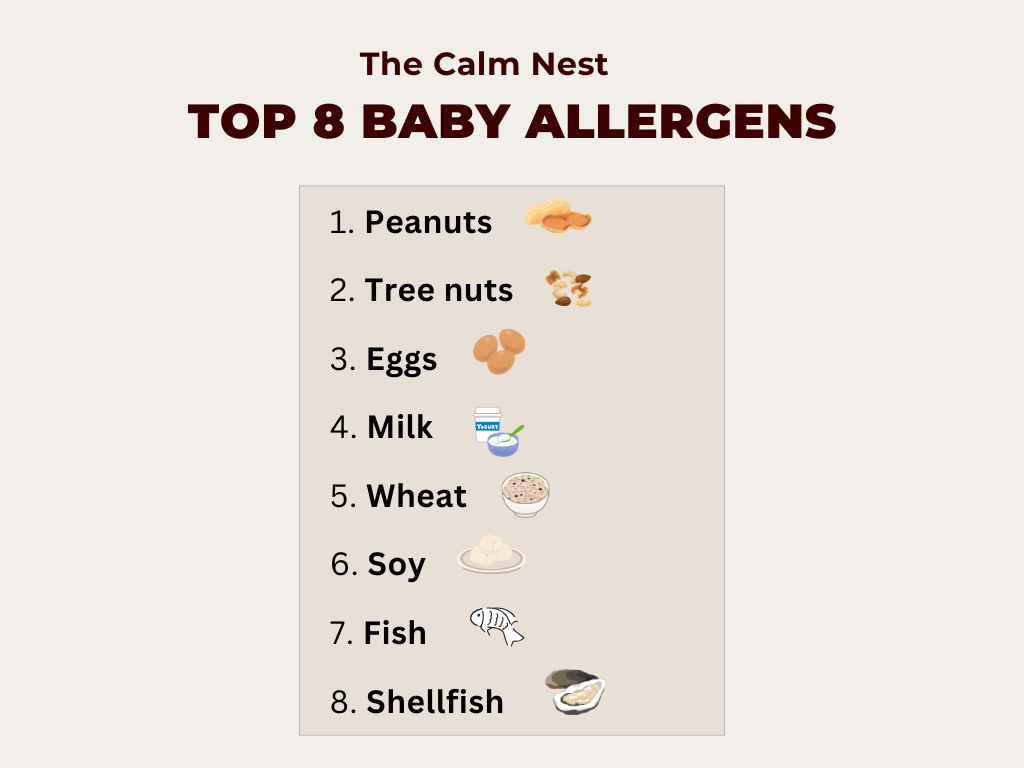
Seeing everything listed together made the whole process feel much less intimidating for me. Once I realised it was just one food at a time, it suddenly felt manageable.
| Allergen | Safe Starting Form |
| Peanuts | Smooth peanut butter thinned with water or breast milk |
| Tree nuts | Almond or cashew butter, well diluted |
| Eggs | Pureed or well-scrambled — fully cooked |
| Cow’s milk | Yogurt or soft cheese (not cow’s milk as a drink under 12 months) |
| Wheat | Soft porridge, soft bread, or pasta |
| Soy | Soy yogurt or soft tofu |
| Fish | Pureed white fish — well cooked |
| Shellfish | Pureed, well cooked — introduce with caution |
When to Start Introducing Allergens
When you start introducing solid foods to your baby from around 6 months, introduce the foods that can trigger allergic reactions one at a time so that you can spot any reaction.
If your baby has eczema, a known food allergy, or a close family history of food allergies, speak to your GP or health visitor before starting. For babies with severe eczema or an existing egg allergy, current guidance recommends introducing peanut products as early as 4 to 6 months under medical guidance, as this group has a higher risk of developing peanut allergy.
For babies without these risk factors, starting allergen introduction alongside other solid foods from around six months is the general recommendation.
How to Introduce Allergens to Your Baby Safely
This is the part that sounds more complicated than it actually is in practice.
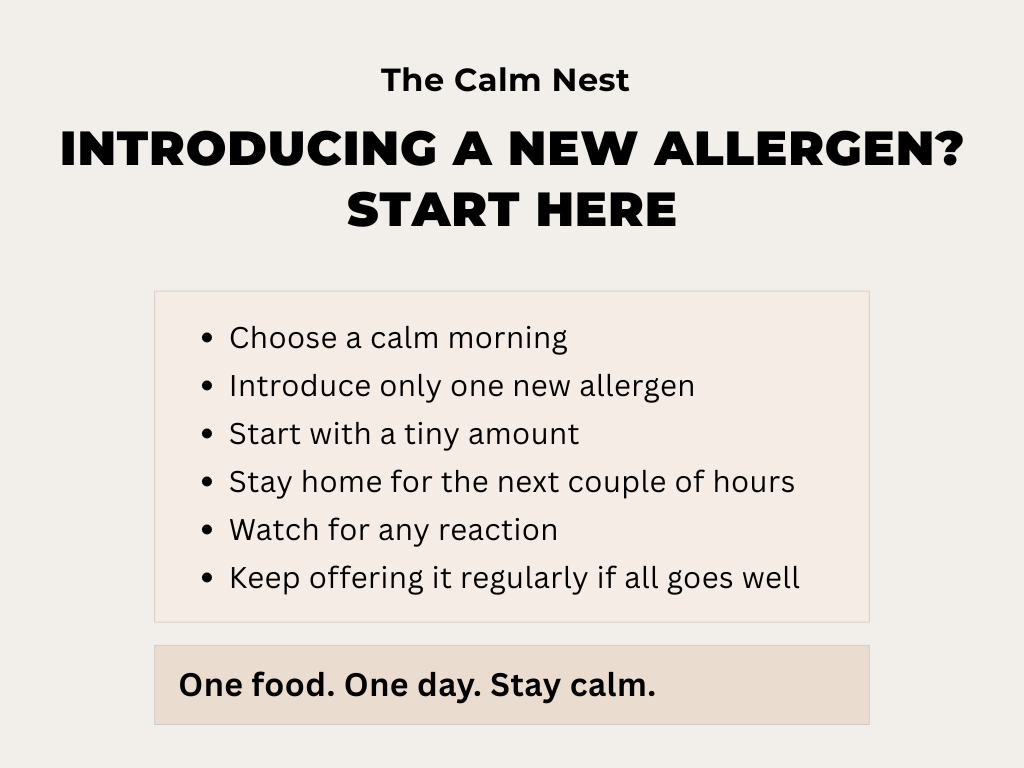
Start one at a time
The AAP recommends introducing only one new food at a time and waiting several days before adding another new food — primarily so you can monitor for food allergies and identify reactions.
The guideline is usually three to five days between each new allergen. That said, I personally left much longer between each one — sometimes a month — because my daughter takes time to adjust to new tastes and textures. Both approaches are valid. What matters is that you are introducing one thing at a time and watching carefully.
Start small
Start with a very small amount — around a quarter teaspoon — and if tolerated, increase the quantity over the following days.There is no rush to get to a full portion. Start tiny, watch, and build up gradually.
Choose the right time of day
Introduce a new allergen in the morning or at lunchtime — not in the evening before bed. If a reaction does happen, you want to be awake, alert, and able to get help quickly. Allergic reactions usually appear within a few minutes to two hours of eating.
Keep the environment calm
Do not introduce a new allergen when your baby is unwell, teething badly, or having a difficult day. A calm, settled baby — and a calm, present parent — makes it much easier to observe what is happening.
Keep giving it regularly
This is the part people often miss. Once you are sure your baby does not have a reaction to a food, keep offering it as part of your baby’s regular diet. Introducing an allergen once and then not giving it again for weeks does not build the tolerance that makes a difference. Once it is in, keep it in.
Going Through Each Allergen
This doesn’t have to happen in any particular order. These are simply the easiest ways I found to introduce each one safely.
1. Eggs
Start with a small amount of well-cooked egg — pureed or finely scrambled. Always offer young children eggs that have been well cooked. I started with pureed egg for a couple of months before introducing it in other forms — scrambled, then omelette. My daughter is picky and gets bored with the same thing quickly, so variety helped us both.
2. Peanuts
Never give whole peanuts to a baby or toddler — they are a serious choking hazard. The safe way to introduce peanuts is smooth peanut butter thinned with a little water, breast milk, or formula until it is a runny consistency, then offered on a spoon or stirred into porridge.
3. Tree Nuts
Same approach as peanuts — always in butter form, well diluted, never whole. I used almond powder mixed into my daughter’s porridge, which worked well and she barely noticed it was there.
4. Cow’s Milk
Cow’s milk as a main drink is not recommended under 12 months, but dairy products like yogurt and soft cheese can be introduced from around six months. Yogurt was a big hit with my daughter — one of the few things she took to immediately. Soft cheese is next on our list.
5. Wheat
Soft porridge, well-cooked pasta, or soft bread are all good starting points. I introduced wheat in porridge form and it went smoothly with no reaction.
6. Soy
Soft tofu or soy yogurt are the easiest forms for young babies. Introduce in small amounts in the same way as other allergens.
7. Fish
Pureed white fish, well cooked. Start with a mild fish like cod or haddock rather than something strongly flavoured. The AAP also notes children should not eat more than 12 ounces of fish per week due to concerns about mercury levels, particularly in larger fish.
8. Shellfish
Introduce cautiously and only when your baby is comfortable with other foods. Pureed and well-cooked. Because shellfish allergies can be more severe, this one is worth discussing with your health visitor first if you have any concerns.
Signs of an Allergic Reaction to Watch For
Most reactions, if they happen, appear within minutes to two hours of your baby eating a new food. Knowing what to look for makes those first introductions much less frightening.
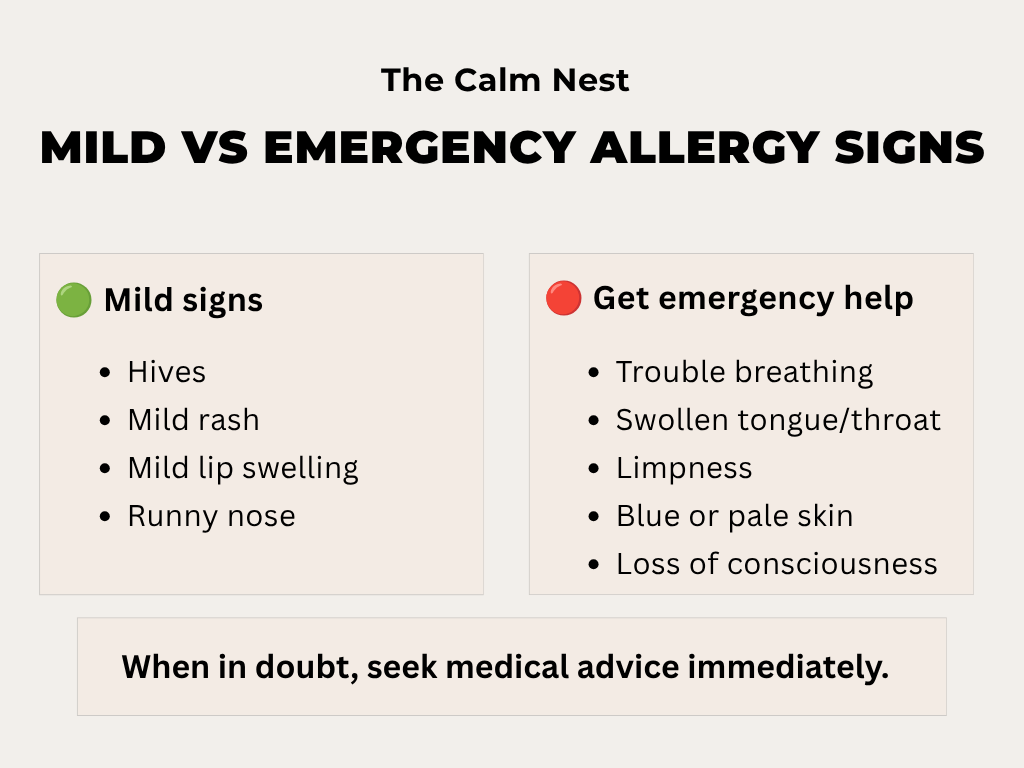
Mild signs:
- Hives or a red rash, particularly around the mouth or face
- Mild swelling of the lips
- Runny nose or watery eyes
- A rash on the body
Most babies never experience a serious reaction. Knowing these signs isn’t about expecting the worst—it’s about feeling prepared, just in case.
Signs that need urgent attention — Call your local emergency number and get medical help immediately:
- Swelling of the face, tongue, or throat
- Difficulty breathing or wheezing
- Vomiting
- Sudden limpness or loss of consciousness
- Skin that goes pale or blue
If you think your baby has had a reaction to any food or ingredient, contact your doctor or a medical helpline for advice. Do not remove food groups from your baby’s diet without medical advice, as this may leave them without nutrients they need.
Severe reactions are rare. The risk of a severe allergic reaction, even in babies at higher risk, is much less than one percent. Knowing this does not mean you should be careless — but it does mean that the worry most parents feel before introducing allergens is often much bigger than the actual risk.
What If You Are Going Slower Than the Guidelines Suggest?
Honestly, I went much slower than most guides recommend — a month between allergens rather than three to five days. And everything has been fine.
The three-to-five-day guidance exists so you can clearly identify which food caused a reaction if one occurs. Going more slowly does not cause harm — it just means introduction takes longer overall. If your baby is a slow adjuster like mine, or if you feel more comfortable taking your time, that is a valid choice. What matters is that you do introduce each allergen at some point, rather than avoiding them indefinitely.
If you are going slowly by choice, that is one thing. If you are avoiding allergens out of fear and not introducing them at all, that is worth discussing with your health visitor — because avoiding them long-term can actually increase the risk of allergy rather than reduce it.
When to Talk to Your Doctor or Health Visitor
Speak to your GP or health visitor before starting allergen introduction if:
- Your baby has eczema, particularly moderate or severe
- Your baby has already had a reaction to any food
- There is a family history of food allergies, eczema, asthma, or hay fever
- You are unsure which allergens your baby may have already been exposed to through breast milk
Speak to them immediately if your baby shows any signs of an allergic reaction after trying a new food. Do not wait to see if it gets better on its own.
Questions Mums Actually Ask
My baby had a small rash after trying eggs. Does that mean they are allergic?
Not necessarily — but it is worth getting it checked. A small rash around the mouth is sometimes contact irritation rather than a true allergic reaction. A larger rash, hives spreading beyond the face, or any other symptoms alongside the rash are more significant. Call your doctor and describe what you saw. Do not reintroduce the food until you have spoken to someone.
Do I have to introduce all eight allergens before my baby turns one?
Current advice is to introduce all common allergenic foods that your child is not allergic to, and which are part of your family’s usual diet, before one year of age. That said, life is not always that tidy. I have not introduced everything yet. If you are working through them gradually and making progress, you are doing the right thing.
Can I introduce more than one allergen on the same day?
It is generally not recommended. If you introduce two at once and a reaction occurs, you will not know which food caused it. One at a time — with enough days between — is the safest approach.
What if my baby refuses the food I am trying to introduce?
Try again another day. Babies often need multiple exposures to a new taste before accepting it. Try mixing it into something they already enjoy, offering it in a different texture, or just keeping it on the plate alongside familiar food. Do not force it — patience is much more effective than pressure.
Take It One Allergen at a Time
Introducing allergens felt like a big deal before I started. Looking back now, it was just another part of feeding my daughter — done slowly, carefully, and without drama.
My approach was not by the book in terms of timing. I went at her pace, waited until she seemed settled with one food before trying the next, and made sure I was calm and present each time. That worked for us.
Your version of this might look different. You might go faster, or slower, or in a different order. All of that is fine as long as you are introducing each allergen and watching your baby closely.
There isn’t one perfect way to do this. The important thing is simply getting started, one allergen at a time.
Keep Reading
Save this guide for when you are working through allergen introduction — it is a process that takes weeks, and having something clear to come back to helps.
These guides sit alongside this one well:
→ Baby Wake Windows by Age — a well-rested baby is usually a more receptive eater
→ How Many Naps Does a Baby Need by Age — nap timing around mealtimes makes a real difference
→ Baby Bedtime Routine Guide — a calm daily rhythm supports everything, including mealtimes
Sources
NHS — Food Allergies in Babies and Young Children | NHS — Foods to Avoid Giving Babies and Young Children | American Academy of Paediatrics — When to Introduce Common Food Allergens | AAP — Early Introduction of Peanut-Based Foods | Allergy Asthma Network | North West NHS Allergy Network — Weaning Advice | Colorado State University Extension

