Baby Sleep Training Methods: A Simple, Honest Comparison
When Ayra was a baby, getting her to sleep was only half the job.
She usually fell asleep after a feed or with me patting and gently rocking her in my lap. But I could not put her down straight away. I had to wait until she was deeply asleep, and even then, sometimes the moment I moved her, she would wake, and I would start patting her all over again.
Even once she was asleep, I often stayed beside her. If I got up to do something around the house, there were times when she would wake only a few minutes later.
At the time, I was not thinking about sleep habits or baby sleep training methods. I was tired and doing whatever helped her sleep.
Looking back, I probably would have given her more opportunities to settle without me right beside her. Not because I think comforting a baby to sleep is wrong — I did plenty of it — but because nobody ever explained to me that there were different ways of approaching sleep.
I thought you either helped your baby to sleep or left them to cry.
There is actually a lot in between.
So this is not a guide telling you that you should sleep-train your baby, or that one method is best. It is simply the comparison I wish I had understood when Ayra was little.
What Does Sleep Training Actually Mean?
“Sleep training” is a broad term used for different approaches that aim to help a baby settle to sleep with less help from a parent.
That can mean very different things depending on the method.
One approach might involve leaving the room and returning for brief check-ins. Another keeps you beside your baby and gradually reduces your help. Some approaches involve more crying than others.
And you do not have to use a formal sleep-training method at all.
Feeding, rocking or comforting a baby to sleep is not automatically a problem simply because another family does things differently. The question is whether your current routine is working for your baby and for you.
Sleep Training Methods at a Glance
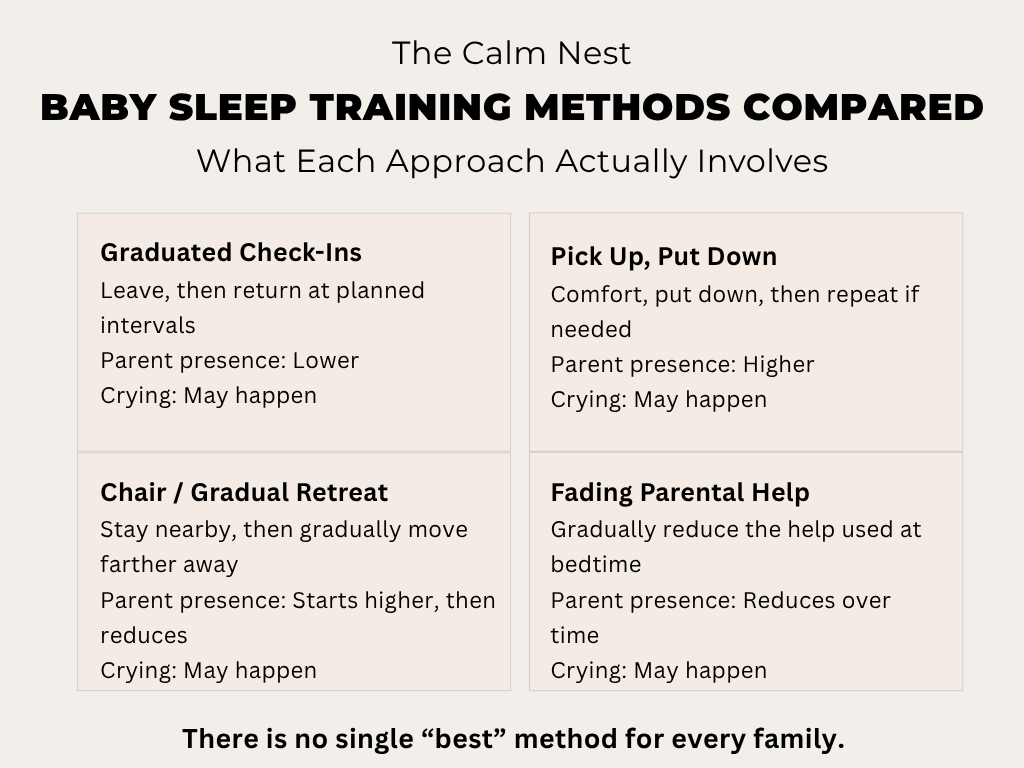
Here is the simplest way to understand some of the methods you are likely to come across.
| Method | What it involves | Parent presence | Crying may happen? |
| Graduated check-ins / Ferber-style | Leaving for planned periods, then returning briefly to reassure | Less | Yes |
| Fading parental presence | Gradually reducing how much help and presence you give at bedtime | Starts higher, then reduces | Possibly |
| Pick up, put down | Comforting your baby, putting them down, and picking them up again when needed | High | Possibly |
| Chair / gradual retreat | Staying close at first, then gradually moving farther away | Starts high, then reduces | Possibly |
This is a comparison, not a ranking. There is no single method that will feel right for every baby or every parent.
There is also some overlap between the names parents see online. For example, the chair method is essentially one way of gradually fading parental presence.
And bedtime fading is something different again — we will come to that below.
1. Graduated Check-Ins / Ferber-Style Sleep Training
This is probably what many parents picture when they hear the words “sleep training.”
With graduated check-ins, you put your baby down for sleep and leave. If they cry, you wait for a planned period before returning briefly to reassure them.
You then leave again, with the periods between check-ins generally becoming longer.
The idea is that the baby has opportunities to settle without being rocked, fed or held all the way to sleep, while the parent still returns at intervals.
Does it involve crying?
It can.
That is important to say plainly rather than dressing it up with softer language.
If listening to your baby cry while waiting before going back in feels unbearable to you, that matters. A method may look straightforward on paper and still feel completely wrong when it is your own baby crying in the next room.
I know that would have been difficult for me.
When Ayra cried as a baby, I could usually give her a little time and try patting her first. But if that was not working and she became more upset, I picked her up and settled her in my lap.
That was what felt natural to me.
2. Fading Your Help Gradually
This approach starts with the help your baby already receives and gradually reduces it.
For example, a parent who normally stays very close while their baby falls asleep might slowly reduce their presence or interaction over time.
This one is particularly interesting to me looking back because staying close was exactly what I did.
Ayra was such a light sleeper that I often felt I could not leave once she was asleep. At the time, staying beside her was simply what worked.
If I could go back, I think I would have tried giving her small opportunities to settle with a little less help as she got older, rather than changing everything suddenly.
That is a personal choice I would make based on our experience — not something every mother needs to do.
3. Pick Up, Put Down
This is one of the more hands-on approaches parents may come across.
The basic idea is simple: you put your baby down, offer reassurance, and if they become too upset, you pick them up and comfort them. Once they are calmer, you put them down again.
This may be repeated.
This is probably the closest to what I naturally did with Ayra, although I was never deliberately following a method.
If she stirred or started crying, I usually tried patting her first. If that did not work, I picked her up and settled her on my lap.
Does this mean there will be no crying?
Not necessarily.
A baby can still become upset when something about their usual way of falling asleep changes.
The difference is that this approach allows for a lot of hands-on reassurance.
It can also involve plenty of picking up and putting down, which may feel tiring in its own way.
4. The Chair Method / Gradual Retreat
With this approach, you remain close while your baby falls asleep and gradually increase the distance between you over time.
For example, you might begin right beside the sleep space, then move your chair farther away every few nights until eventually you are outside the room.
The exact way families do this can vary.
The important distinction is that you are not suddenly removing your presence. You are reducing it gradually.
This is really a form of fading parental presence, which is why you may see different names used for very similar approaches.
Does it prevent crying?
No method can promise that.
Even when a parent remains in the room, a baby may protest when something about their familiar sleep routine changes.
What Is Bedtime Fading?
This is worth explaining separately because the name is confusing.
Bedtime fading is not the same thing as gradually moving yourself farther away from your baby.
Instead, bedtime is temporarily moved closer to the time when the child naturally falls asleep. Once falling asleep becomes easier, bedtime is gradually moved earlier.
Research has examined bedtime fading alongside other behavioural sleep approaches, but that does not mean it is appropriate for every baby or that parents should start changing bedtime without considering their child’s age, sleep needs and individual situation.
If you are unsure, particularly with a younger baby, this is something you can discuss with your paediatrician or health visitor.
What About “Cry It Out”?
This phrase gets used so loosely online that it can make the whole subject more confusing.
Full extinction — often called “cry it out” — and graduated check-ins are not the same approach.
With graduated check-ins, parents return after planned periods to briefly reassure their child.
With full extinction, parents generally do not return in response to crying after bedtime unless there is a concern such as illness or safety.
You do not have to choose either approach simply because you want sleep to improve.
That is one of the things I wish I had understood earlier.
There are approaches involving much more parental presence, and there is also the option of not using a formal sleep-training method at all.
Does Sleep Training Actually Work?
This deserves a careful answer rather than a promise.
Research has found that some behavioural sleep approaches can improve certain sleep problems for some babies.
One randomised trial followed 43 babies aged 6 to 16 months. Babies were assigned to graduated extinction, bedtime fading or sleep education. Both behavioural approaches improved some measures of sleep compared with the education-only group. At the 12-month follow-up, the researchers did not find significant differences between the groups in the measures they used for attachment or children’s emotional and behavioural problems.
But this was a small study.
So I would not turn it into the much bigger claim that every sleep-training method is proven to work for every baby or that research can tell you which method your family should choose.
It cannot.
The evidence is also much stronger for some behavioural approaches than for every named “gentle sleep training method” you may see online.
That is why I would be cautious with anyone promising that one particular method will definitely make your baby sleep through the night.
When Can You Start Sleep Training?
There is no single age at which every baby suddenly needs to be sleep trained.
During the newborn months, babies wake frequently and need responsive care and feeding. Their sleep is still developing.
From around 4 months, parents may start encouraging some independent settling habits, such as putting a baby down when drowsy rather than waiting until they are completely asleep.
But that is not the same thing as saying every formal sleep-training method should begin at four months.
The study discussed above, for example, looked at graduated extinction and bedtime fading in babies aged 6–16 months.
So rather than choosing an age from a Pinterest chart, consider your baby’s age, feeding, health, development and sleep pattern. If you are considering a formal behavioural approach with a young baby and are unsure whether it is appropriate, talk to your paediatrician or health visitor first.
Before You Choose a Sleep Training Method
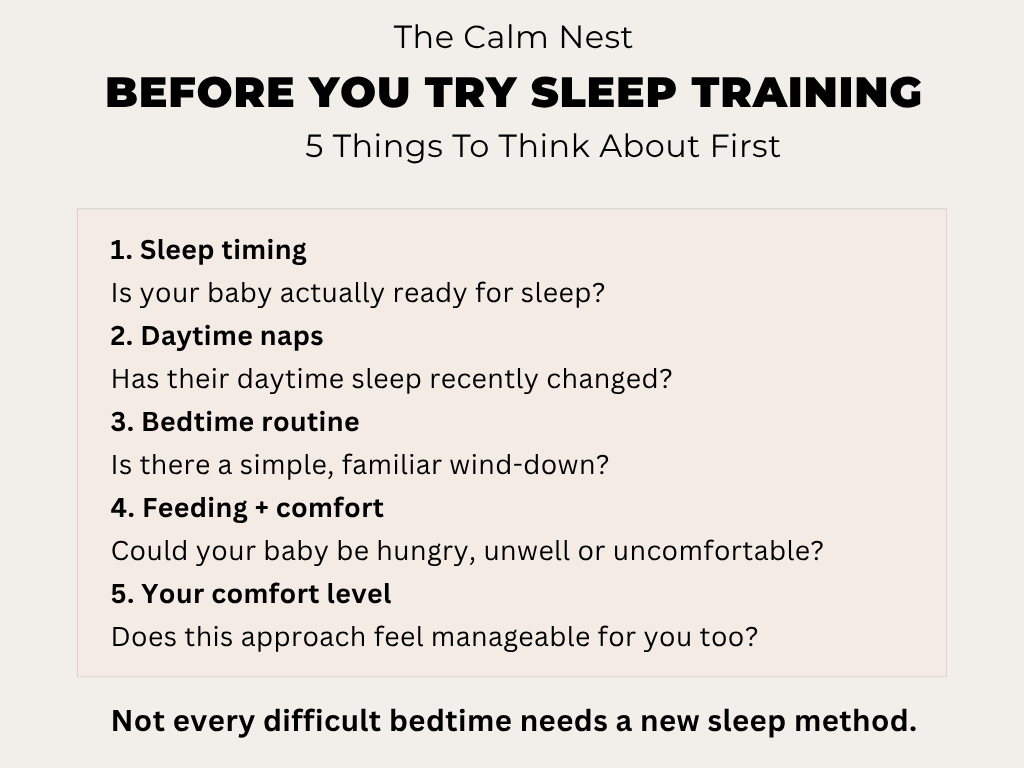
Before changing the way your baby falls asleep, I would look at a few simpler things first.
Is your baby actually tired?
Sometimes a baby who fights bedtime simply is not ready to sleep yet.
And sometimes they have been awake too long and are already exhausted.
If sleep timing is confusing, my Baby Wake Windows by Age guide explains how I use wake windows as a flexible guide rather than a strict clock.
Is daytime sleep changing?
Nap needs change considerably during the first year.
If a nap is disappearing or daytime sleep has changed, bedtime may feel different too.
You can read How Many Naps Does a Baby Need by Age? for a closer look at nap changes through the first year.
Do you have a simple bedtime routine?
A predictable wind-down can help signal that sleep is coming.
It does not need to be complicated. Dimmer lights, changing clothes, a feed where appropriate, a cuddle, a book or song can all be part of a calm routine.
My Baby Bedtime Routine Guide walks through this in more detail.
Could your baby need something else?
Not every wake-up or cry is something a baby needs to learn to settle through.
They may need feeding, a nappy change, comfort because they are unwell, or simply your help.
Sleep training should never mean ignoring a baby’s health, feeding or safety needs.
Sleep Training and Night Weaning Are Not the Same Thing
This distinction is really important.
Helping a baby learn a different way to fall asleep does not automatically mean that they no longer need milk overnight.
Whether a baby still needs night feeds depends on factors including age, feeding and individual health and growth.
Do not remove necessary night feeds simply because you have started changing how your baby settles to sleep.
If you are unsure whether your baby is ready to reduce night feeds, speak to your paediatrician or health visitor.
Safe Sleep Still Comes First
Whatever approach you use, safe sleep guidance does not change.
For babies under 1:
- Place your baby on their back for sleep.
- Use a firm, flat, non-inclined sleep surface intended for infant sleep.
- Keep pillows, loose bedding, toys and other soft objects out of the sleep space.
- For at least the first 6 months, keep your baby’s separate sleep space in the same room where you sleep.
Sleep training should never involve changing the sleep environment in a way that makes it less safe.
What If I Don’t Want to Sleep Train?
Then you don’t have to.
That sentence deserves to stand on its own.
There can be so much pressure around baby sleep that it starts to feel as though every family eventually has to choose a method.
You don’t.
If feeding, rocking, patting or staying nearby works for your family and you are comfortable continuing, you do not need to change it simply because another baby falls asleep differently.
And if what you are doing is exhausting you, you are also allowed to want something to change.
Both can be true.
When to Speak to Your Paediatrician or Health Visitor
Ask for professional advice if:
- You are concerned about your baby’s sleep or frequent waking.
- Your baby seems unwell, uncomfortable or in pain.
- Sleep difficulties are affecting feeding or growth.
- You are unsure whether your baby still needs feeds overnight.
- You are considering sleep training but are unsure whether it is appropriate for your baby’s age or circumstances.
- Your own sleep deprivation is becoming difficult to manage.
You do not have to wait until you are completely exhausted before asking for help.
Questions Mums Actually Ask
Which sleep training method is the gentlest?
There isn’t one universally agreed “gentlest” method.
If by gentle you mean more parental presence and hands-on reassurance, approaches such as gradual fading or pick-up/put-down involve more direct parental involvement than graduated check-ins.
That does not mean one is automatically better for your baby.
The method you can respond to calmly and consistently may look different from the method another family is comfortable using.
Does sleep training mean leaving my baby to cry?
Not necessarily.
Some methods involve periods when a baby may cry without being picked up immediately. Others keep the parent close and use more hands-on comforting.
And no method can guarantee zero crying when a baby’s familiar sleep routine changes.
Is the Ferber method the same as cry it out?
Not exactly.
Ferber-style graduated check-ins involve returning at planned intervals to briefly reassure your baby.
Full extinction generally does not involve those scheduled reassurance visits.
Can I still comfort my baby if I am trying to encourage independent sleep?
Yes.
Encouraging independent settling does not mean you have to ignore feeding, illness, pain, a dirty nappy or another genuine need for comfort.
What if I start a method and it feels wrong?
You can stop.
Choosing a sleep approach is not a contract.
If something feels unmanageable, your baby is becoming increasingly distressed, or you are worried about their health or feeding, reassess what you are doing and get professional advice if you need it.
There Isn’t One Right Way to Help a Baby Sleep
Ayra is 20 months old now, and sleep looks completely different from those early months.
She is much easier to settle, and these days she falls asleep lying beside me.
A lot changed simply with time and age.
If I could go back, I probably would give her more opportunities to settle without me staying beside her every time. But I also understand why I did it.
I was tired. She was finally asleep. And I was doing what worked for us at that moment.
That is why I don’t think choosing between sleep training methods should start with asking which one is “best.”
I think it starts with understanding what each method actually asks you and your baby to do, knowing what you are comfortable with, and remembering that you do not have to choose a formal method at all.
Keep Reading
If baby sleep still feels confusing, these guides may help:
→ Baby Wake Windows by Age: Complete Guide for 0–12 Months
→ How Many Naps Does a Baby Need by Age? (0–12 Months Guide)
Sources
American Academy of Paediatrics — Getting Your Baby to Sleep | American Academy of Paediatrics — How to Keep Your Sleeping Baby Safe: AAP Policy Explained | Gradisar M et al. — Behavioural Interventions for Infant Sleep Problems: A Randomised Controlled Trial. Pediatrics. 2016;137(6):e20151486 | NHS — Helping Your Baby to Sleep
*This article is for general educational information and is not a substitute for advice from your baby’s paediatrician, doctor or health visitor.*