Baby Wake Windows by Age: The Complete Guide for 0–12 Months

I still remember the night everything changed.
Honestly, I thought I had it sorted.
For the first two months, my daughter slept so well. Feed her, put her down, and she would sleep. Simple. I was quietly very pleased with myself… maybe even a little too proud.
Then month three came. And everything flipped.
She stopped napping. Or she would fall asleep for ten minutes — fifteen if I was lucky — then wake up as she had just had a full night’s rest. Meanwhile, I was running on nothing.
I tried everything. Warm baths before naps. White noise. Rocking her for longer. Feeding her more. Everyone had a suggestion, and I tried all of them.
Nothing worked.
Weeks went by where I felt like I was doing something wrong… like maybe I was just bad at this.
If that sounds familiar right now, I want you to hear this first.
You are not failing. Your baby is not broken. You are just missing one piece of information that nobody really explains properly.
It’s called wake windows.
I had never heard of them either. But once I understood what they were and how to use them, things started to make more sense. Not perfect. Not overnight. But better.
This guide is everything I wish someone had given me back then. It’s simple, clear, and straight to the point — because when you are running on no sleep, that’s exactly what you need.
Let’s get into it.
In This Guide
What wake windows are
Baby wake windows by age
Signs your baby is tired or overtired
How to use wake windows each day
Common mistakes to avoid
When to speak to a professional
What Are Wake Windows?
A wake window is simply the amount of time your baby can comfortably stay awake between one sleep and the next.
That is it. Nothing complicated.
It starts the moment your baby wakes up and ends when they fall back to sleep. Everything in between — the feed, the nappy change, the play on the mat, the cuddle — all of that counts.
The idea is this: every baby has a natural limit for how long they can stay awake before they need sleep again. Go past that limit, and your baby becomes overtired. Stay too far under it, and they are not tired enough to sleep well.
The goal is to find the sweet spot in the middle. And that sweet spot changes as your baby grows.
Baby Wake Windows by Age: 0 to 12 Months
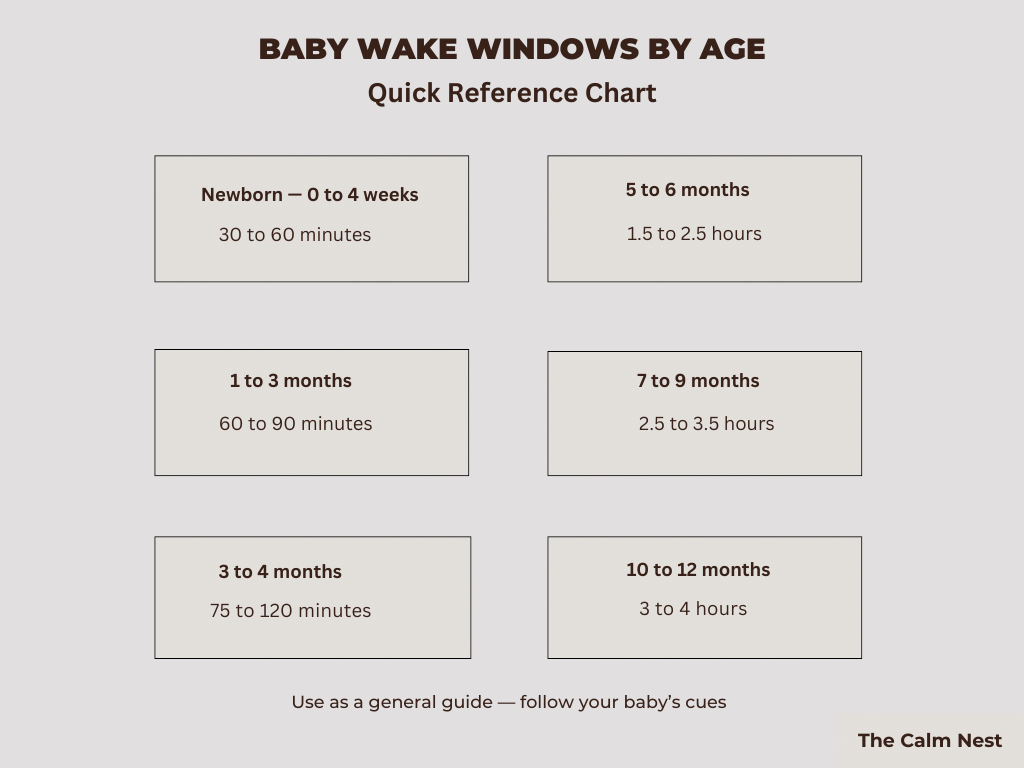
Save this section — you will come back to it often.
These are guidelines, not rules. Every baby is slightly different. Use these as your starting point, then watch your baby’s cues to fine-tune.
Newborn — 0 to 4 weeks
Wake window: 30 to 60 minutes | Naps: 4 to 5 per day
Everything is short at this stage. Your newborn can barely finish a feed before they are ready to sleep again. That is completely normal — their only job right now is to eat, sleep, and grow.
1 to 3 months
Wake window: 60 to 90 minutes | Naps: 4 to 5 per day
Baby is becoming a little more alert and curious. Still keep wake time short and calm.
3 to 4 months
Wake window: 75 to 120 minutes | Naps: 3 to 4 per day
This is where many parents — including me — hit a wall. Around this age, your baby’s sleep changes significantly as their brain develops. Naps get shorter, nights get disrupted. It feels like going backwards. It is not — it is a normal developmental shift. Hang in there.
5 to 6 months
Wake window: 1.5 to 2.5 hours | Naps: 3 per day
Baby is more awake and playful now. You will start to notice a more predictable shape to the day.
7 to 9 months
Wake window: 2.5 to 3.5 hours | Naps: 2 to 3 per day
Most babies drop to two naps somewhere in this range. You will know it is time when the third nap starts causing bedtime battles.
10 to 12 months
Wake window: 3 to 4 hours | Naps: 2 per day
Wake windows are much longer now. Two solid naps usually work well at this age.
One important note: Wake windows tend to get slightly longer as the day goes on. The gap before bedtime is usually the longest one of the day. So if your baby handles more awake time in the evenings, that is perfectly normal.
Signs Your Baby Is Ready to Sleep
Knowing the wake window range is only half the picture. The other half is reading to your baby.
Signs your baby is getting tired:
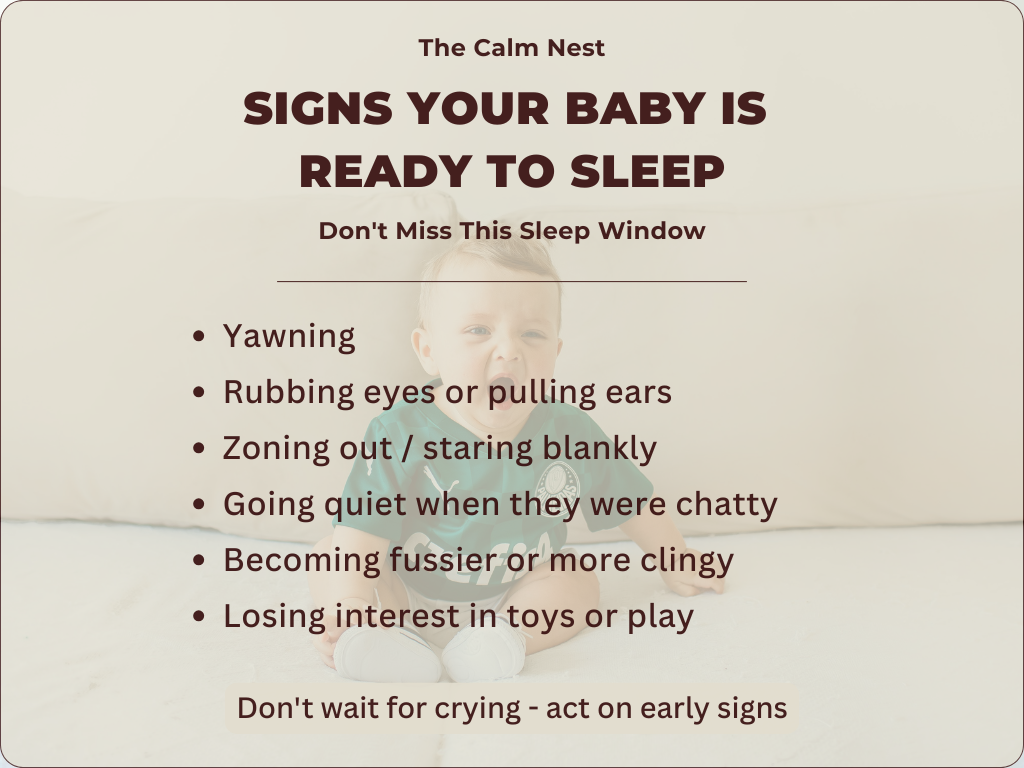
- Yawning — usually one of the first signs
- Rubbing their eyes or pulling at their ears
- Staring blankly, like they have zoned out
- Going quiet when they were chatty a moment ago
- Becoming fussier or more clingy than usual
- Losing interest in toys or play
When you see two or three of these together, start the wind-down. Do not wait for full crying — by that point, your baby is already overtired, and overtired babies are much harder to settle.
Signs your baby is overtired:
- Crying is hard to stop
- Arching their back or going stiff
- Seeming frantic or inconsolable
- Fighting sleep even though they are clearly exhausted
Signs your baby is not tired enough yet:
- Wide awake and happy when you try to put them down
- Very short naps followed by waking up smiling and ready to go
- Taking a long time to fall asleep consistently
If this is happening regularly, try stretching the wake window by 15 to 20 minutes and see if it helps.
How to Use Wake Windows Each Day
You do not need a strict timetable. What you need is a loose rhythm.
When your baby wakes up in the morning, start the clock. Do your feeding, nappy change, a little tummy time or gentle play. When you start seeing tired cues — or when you are nearing the end of the recommended window for their age — begin your wind-down and put them down for a nap. When they wake, start the clock again.
Here’s a simple example of how a day might look using wake windows:
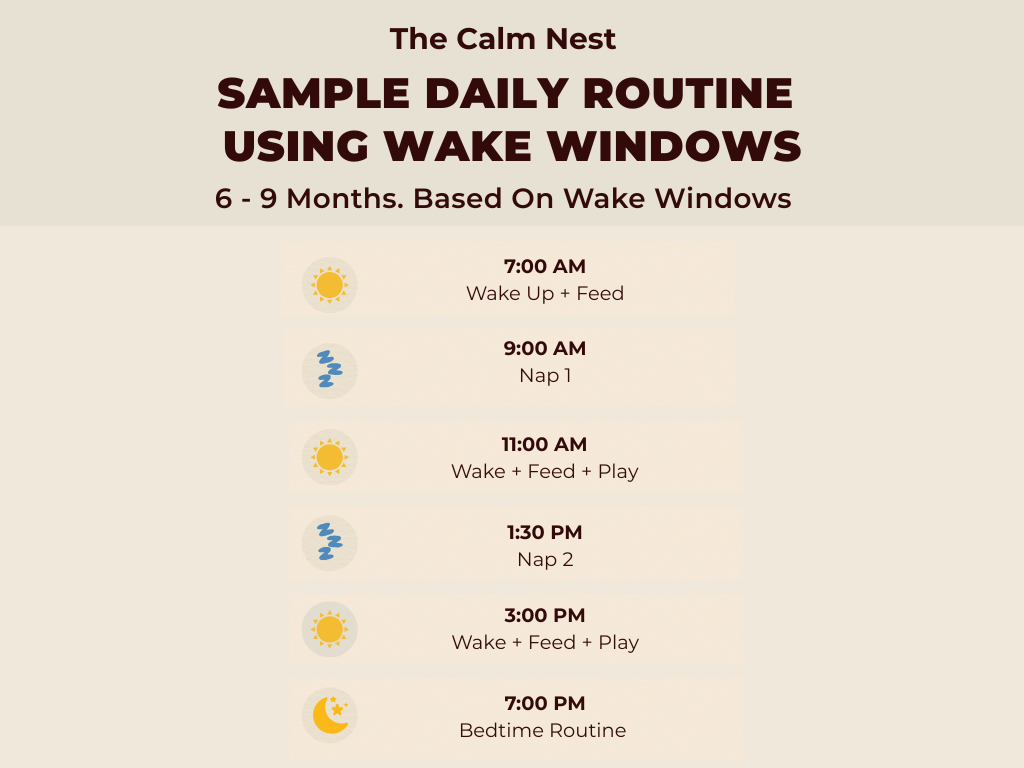
This is just a sample — your baby’s routine may shift based on age and needs.
A few things that help in real life:
- Keep the wind-down simple and consistent. Even five to ten minutes of something calm signals that sleep is coming.
- Do not watch the clock obsessively. Use the window as a guide, not a countdown.
- Expect the routine to shift. As your baby grows, wake windows change — and that is completely normal.
Common Mistakes to Avoid
Keeping the baby up longer, hoping for a longer nap
It rarely works. An overtired baby sleeps more lightly and often wakes earlier.
Ignoring tired cues because the window is not finished
If your baby is yawning early, follow their cues. The window is a range, not an alarm.
Not updating the window as the baby grows
Sleep suddenly worse? The wake window may just need adjusting.
Counting feeding time separately
The clock starts when your baby wakes up — the feed is part of the window.
When to Talk to Your Doctor or Health Visitor
Wake windows are helpful, but they are not a fix for everything.
It is worth speaking to a professional if:
- Your baby seems impossible to settle, even when timing feels right
- You notice snoring or irregular breathing
- Your baby is sleeping much more or less than expected
- Sleep struggles are causing ongoing worry
Trust your instincts. If something feels off, it is always okay to ask.
Questions Mums Actually Ask
“My baby fights sleep even when the wake window seems right. What am I doing wrong?”
Probably nothing. Try starting your wind-down a little earlier so the transition feels calmer.
“My baby only sleeps for 20–30 minutes, then wakes up crying. Why?”
This is often a timing issue. Try adjusting the wake window slightly and give it a few days.
“My newborn’s wake windows are so short — is that normal?”
Yes. It can feel constant in the early weeks, but it does get easier.
“My baby seems tired but won’t fall asleep.”
This is often overtiredness. Even putting them down 10 minutes earlier can help.
“How do I know if it’s working?”
Your baby falls asleep more easily and wakes more settled. That’s the sweet spot.
You Are Doing Better Than You Think
Wake windows are not magic.
Some days, everything will fall into place. Other days, nothing will seem to work, even when you do everything “right.” That is not a failure — that is just baby sleep.
But this gives you something you did not have before.
A starting point.
A way to understand your baby’s rhythm.
Something to come back to when things feel confusing again.
Be patient with your baby.
Be patient with yourself.
This stage does not last forever — and it does get easier.
You have got this.
Keep Reading
Wake windows and nap schedules work together.
Knowing how long your baby can comfortably stay awake is only one part of the picture. The other is understanding how many naps they need at each age.
If you’re not sure whether your baby should be taking 4 naps, 3 naps, or getting ready to drop a nap, read my guide on how many naps a baby needs by age. It walks through nap numbers, nap transitions, and what to expect from newborn to 12 months.
Save This for Later
Wake windows change quickly in the first year — and this is the kind of guide you will want to come back to.
📌 Save this guide now so you always have wake windows handy during nap struggles and overtired days.
Sources
- Mayo Clinic — Baby Sleep: Tips for Newborns
- HealthyChildren.org (American Academy of Paediatrics) — Healthy Sleep Habits for Babies and Children
Want Simple Baby Sleep Help?
Join The Calm Nest for gentle routines, realistic sleep tips, and simple guidance for real parents.
No pressure. Just support.